
Dancing with Disappointment
Infrastructures of Letdown: on surviving as an artist in Singapore, this is not a sad story.

“I release all my anger and frustration towards _ _ _ (insert art institution).
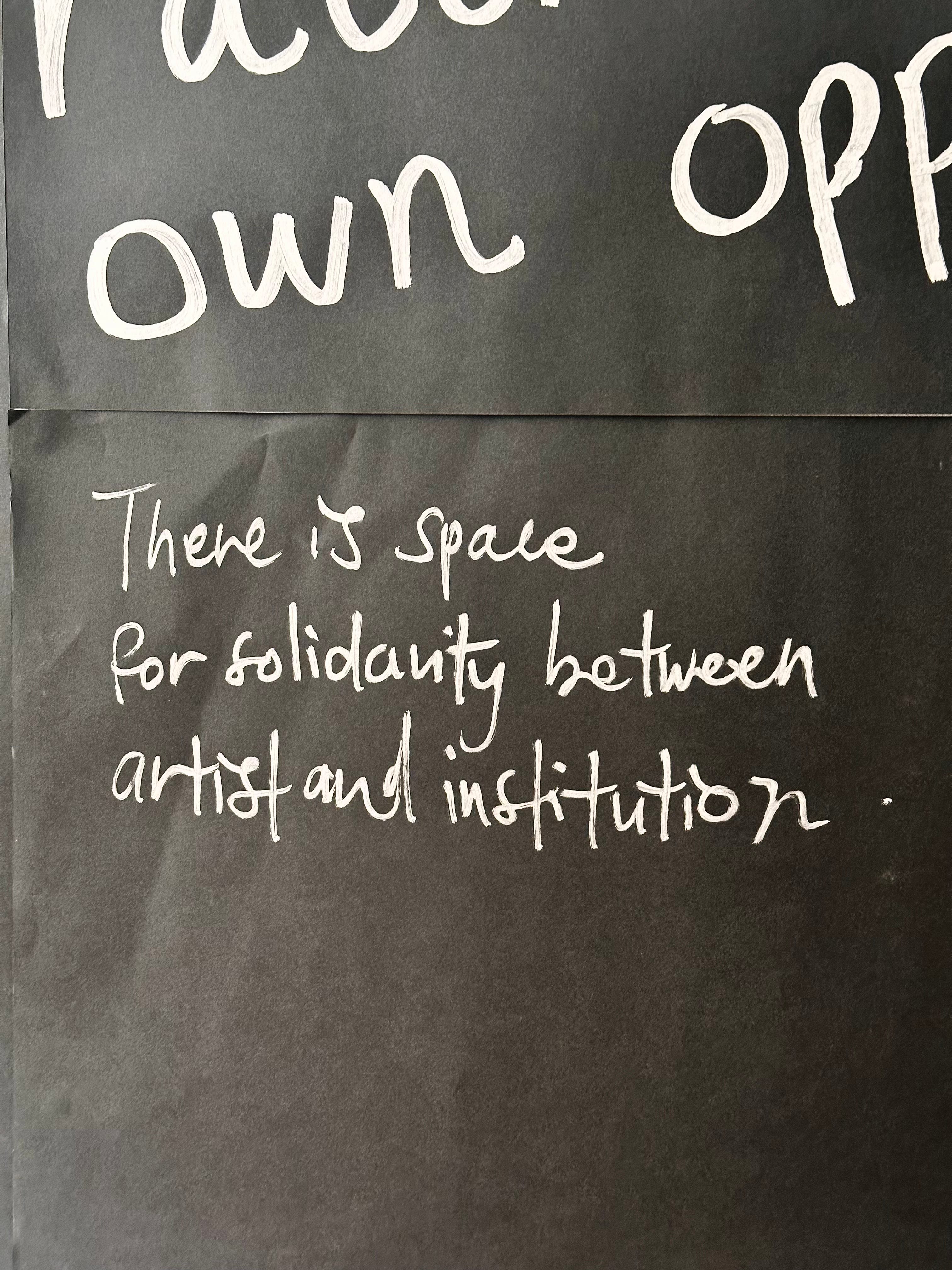
Affirmations for Artists - The Artists’ Institute for Quantum Kinship by Salty Thunder and Ang Kia Yee at double space as part of SG Art Week, 2026
To write about artistic survival in Singapore is to write against a backdrop of red tape and misunderstandings — but also a tenacious history of artistic resistance, negotiation, and subterfuge. The live-art scene here — encompassing dance, experimental performance, theatre, and performance art — has remained deadlocked in an endless dance with state infrastructure and bureaucracy for as long as anyone can remember.
Arts practitioners and organisations who wish to obtain state funding will simply have to continue the endless dance around tenuous out-of-bounds (OB) markers and practise self-censorship, or risk having their funding curtailed.
Hoe, Su Fern. “The Art of Govt Funding Still a Work in Progress.” Channel NewsAsia, 3 Aug. 2017, www.channelnewsasia.com/today/voices/art-govt-funding-still-work-in-progress-5560471.
The purpose of this writing is not to lambast or critique the structures that fund or support the arts in Singapore. In many countries, there is not even an infrastructure for art to begin with, and artists are left to fend for themselves entirely. I am aware of this; hence, I am not entirely ungrateful. Instead, I want to examine the relationship between institutional infrastructure, the surrounding climate, and who is caught between them: the artist.
Infrastructure includes funding bodies, venues, grants, and policies that facilitate art-making, in Singapore most of this is state-controlled. Climate means the environment that nourishes and feeds artists. It covers the socio-cultural conditions of making art: where artists go, how they sustain themselves mentally and spiritually, and what resources they can find outside official channels. Both are important. I am less interested in blaming infrastructure than in understanding how infrastructure and bureaucracy affect the climate—the lived, felt, everyday condition of being an artist in Singapore. That climate, in turn, shapes the kind of art and artists Singapore produces. At the heart of it, I truly wonder: what does the present—or, more pressingly, the younger generation—need in order to carry on? What kinds of alternative viewpoints and resources can independent channels offer to help them understand the current conditions in which they have to make art and survive?
This contradictory nature of state support highlights how the out-of-bounds (OB) markers are obscure and continually redrawn. After all, he who pays the piper calls the tune.
Hoe, Su Fern. “The Art of Govt Funding Still a Work in Progress.” Channel NewsAsia, 3 Aug. 2017, www.channelnewsasia.com/today/voices/art-govt-funding-still-work-in-progress-5560471.
Art by Design
Essentially, it is because of the bureaucracy, but also the “productive” agenda of Singapore—the drive toward measurable outcomes, economic contributions, and nation-building metrics. The National Arts Council (NAC)’s Our SG Arts Plan (2023-2027) explicitly frames the arts as in service of three strategic outcomes: building “a connected society,” creating “a distinctive city,” and driving “the creative economy”. But honestly, what does that even mean?
Community building, capability development, and collaboration—such value systems and expectations ring hollow when the infrastructure that supports the arts is designed primarily to serve national interests and narratives rather than to nourish artistic practice. Until we recognise the value of the artistic process and freedom of failure and experimentation—artists will continue to navigate a opaque infrastructure that supports them only conditionally, and a climate that neuters rather than supports the creative impulse.
I think of Singapore Art Week: the annual frenzy of openings, parties, performances and art fairs. How much of it is genuinely seen or enjoyed by the local arts community? How much is merely content filler? This model, with its frantic pace and metrics-driven logic, is fundamentally hostile and dismissive to the slow, careful, sometimes difficult work that live art requires. Consider this: you are a performance artist invited to perform at a gallery space for $200–$300 SGD per hour. Production costs are not covered. Neither is your rehearsal time or space, nor the invisible labour that builds the performance. On top of that, the work must be inoffensive—nothing that might alienate or offend audiences—nudity obviously is out of the question or anything to do with race or sexuality. It must also not be too loud, too long, or too disturbing. It’s better if you don’t say anything either. Every desire you have, an inconvenience, extra work for everyone. You are not an artist. You are a liability. The payment comes in 3 months late.
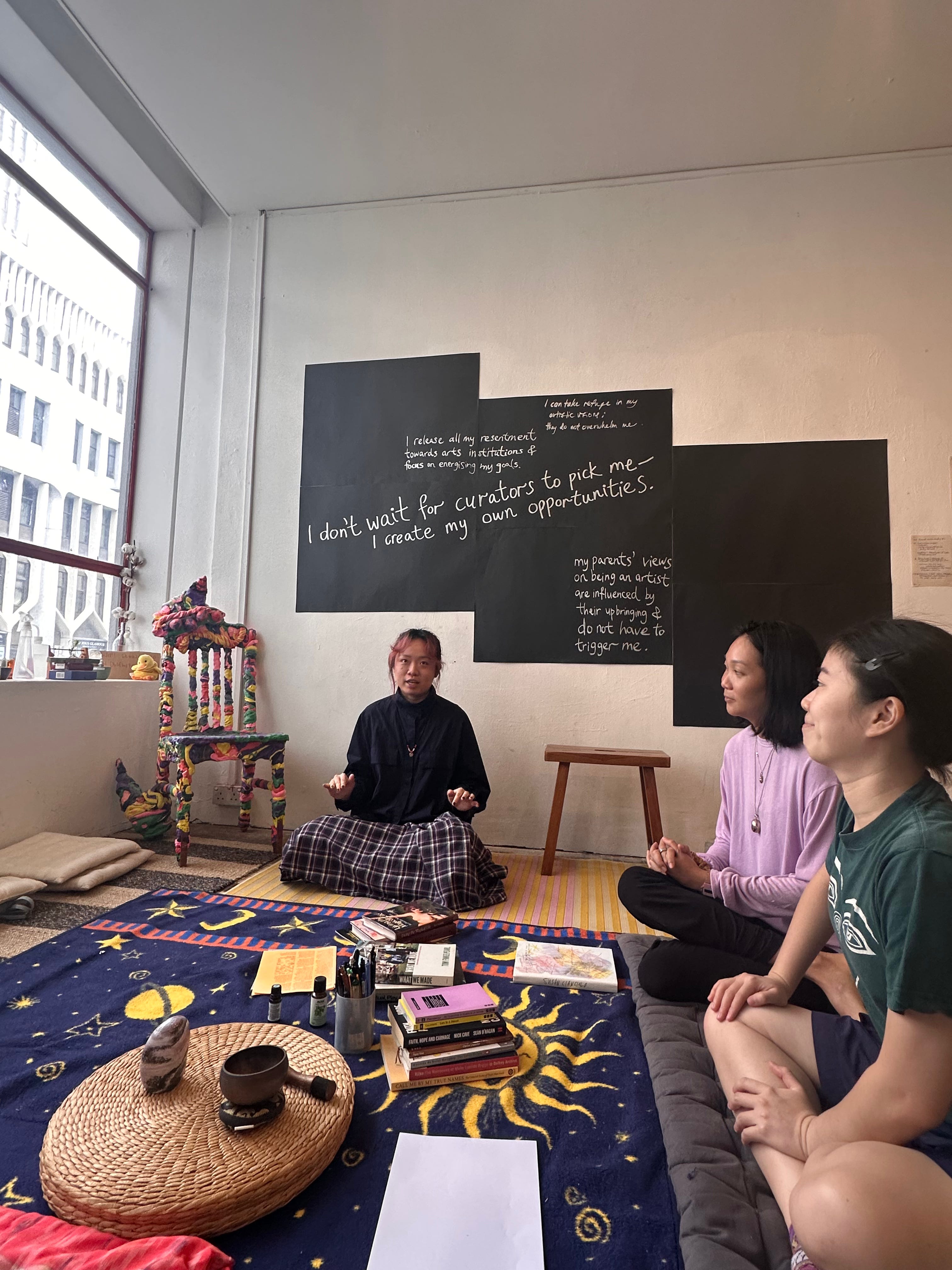
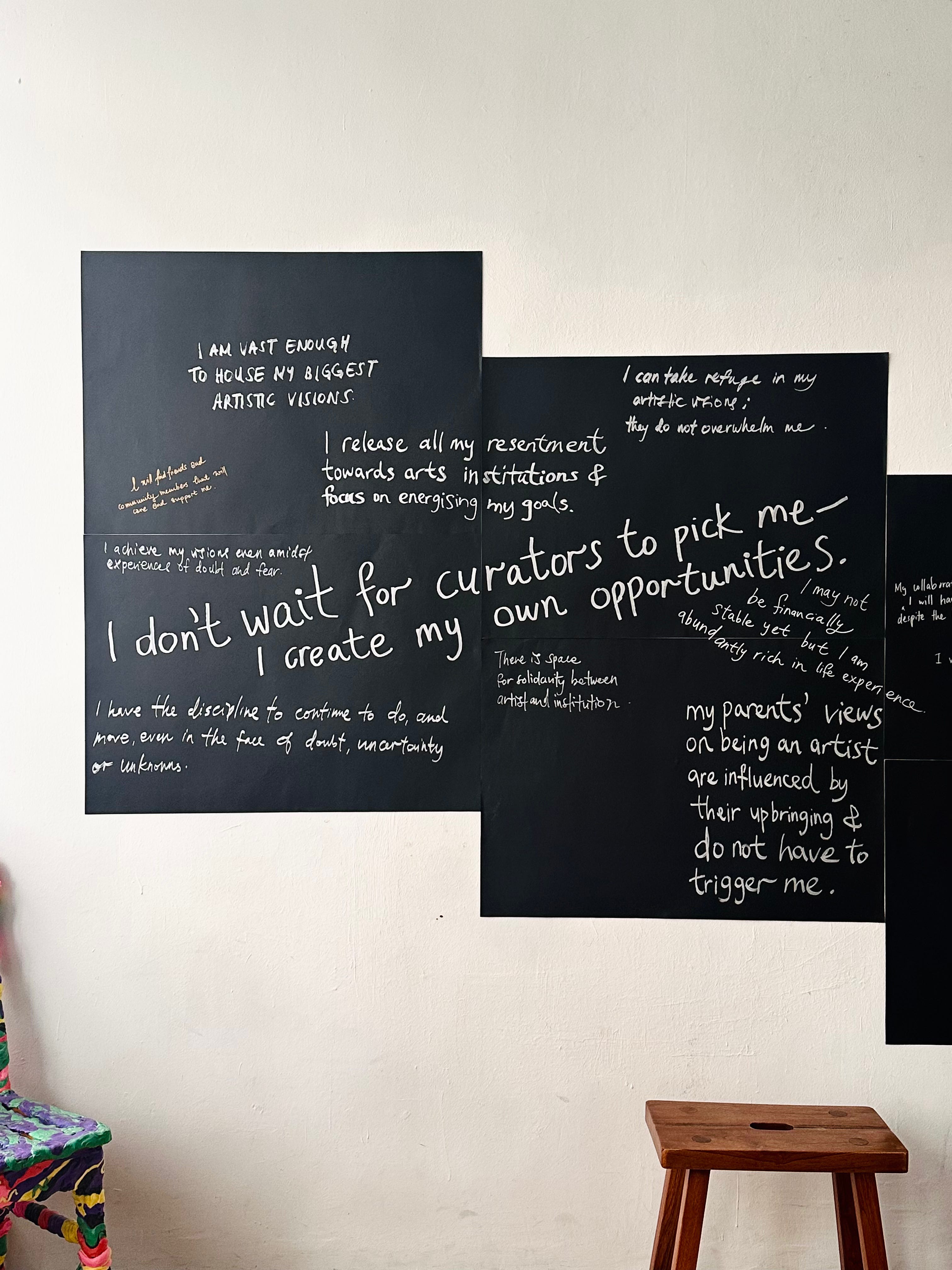
My good friend Salty Xie Jie Ng and artistic collaborator Ang Kia Yee held an affirmations workshop during Singapore Art Week this year during their residency at double space, motivated by an interest in deeply considering the conditions around being an artist in Singapore. Theirs was a tender offering that held space for artists to air their grievances, insecurities and misgivings, but also to create a space for hope and healing. Their workshop began with a mapping exercise around what it means to be an artist in Singapore. They also framed affirmations as a practice—not a one-off thing, but a way to help develop a healthier relationship to art and institution. There was even a meditative soundtrack released, meant to be listened to with your eyes closed. I believe there is a tongue-in-cheek aspect to this offering, but also a sincere desire to help artists develop better relationships to their work and the bodies that hold them. However, what struck me about this workshop is that it was held to reflect on the conditions engendered by the Singapore arts ecosystem. Are things so dire that artists essentially require healing work? Yet, the existence of this space, within the marketplace of Singapore Art Week, felt essential, powerful—a soft resistance. I was not able to attend because I was also paying my dues as a working artist during that period, but knowing that my friend was doing this somehow felt like somebody was rooting for us.
“the original creative urge of individual artists and groups would be given due respect so that their impulses could enjoy sufficient leeway to prove their creative worthiness, or otherwise”
Kuo Pao Kun
Hoe, Su Fern. "The Art of Govt Funding Still a Work in Progress." Channel NewsAsia, 3 Aug. 2017, www.channelnewsasia.com/today/voices/art-govt-funding-still-work-in-progress-5560471.
In recognition that I am a practising artist doing live art in a country where performance art-funding was effectively banned three years after I was born. I am aware that my choice to remain an artist in this country is a masochist's calculation—a daily negotiation between doing what I love and what the system will tolerate.
Sometimes I question: is being an artist in Singapore less about doing what I love than what I want, And do I want it precisely because it is unwanted? Is my real desire is simply to do something I am not supposed to be doing? An artistic existentialist loop.
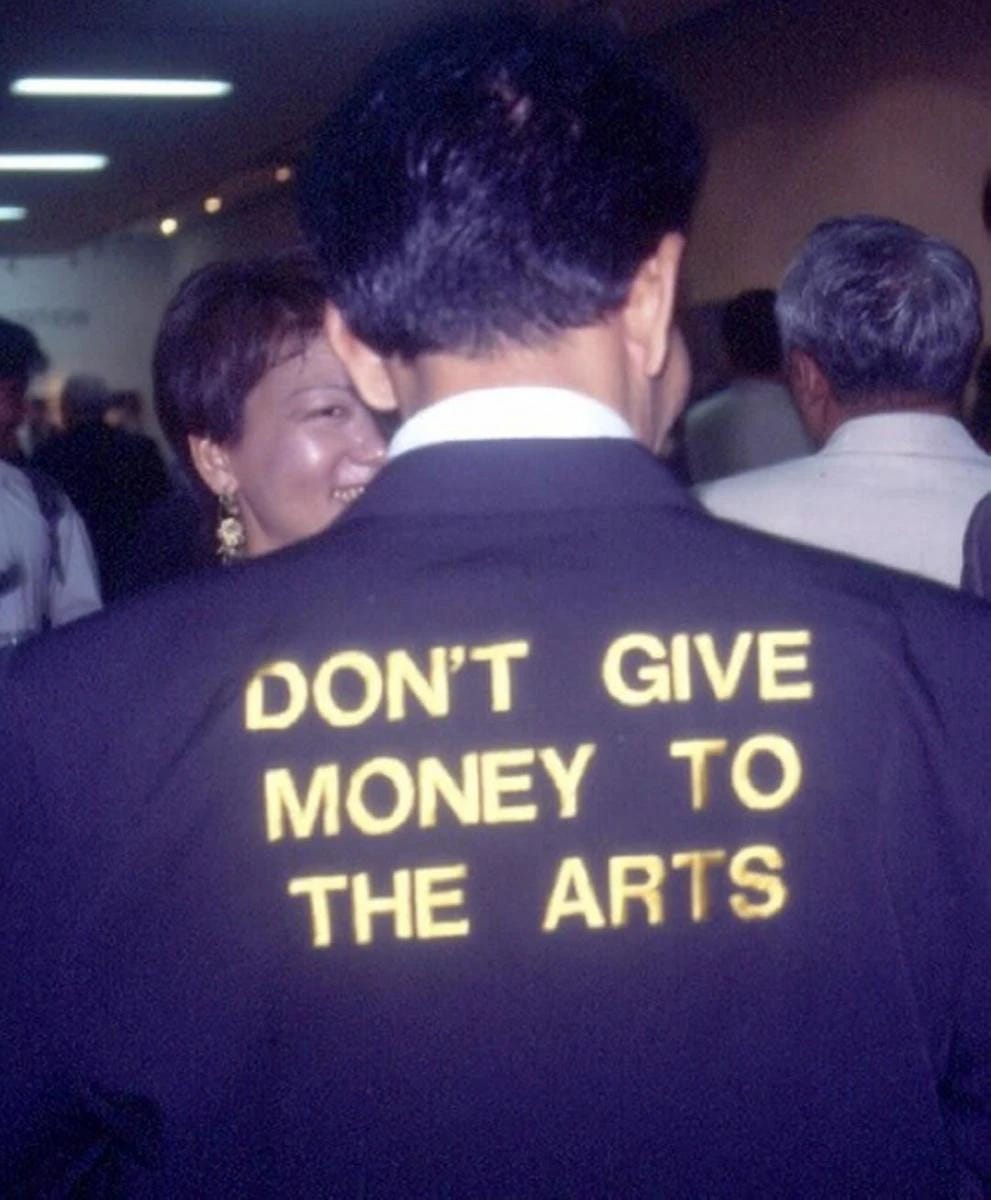
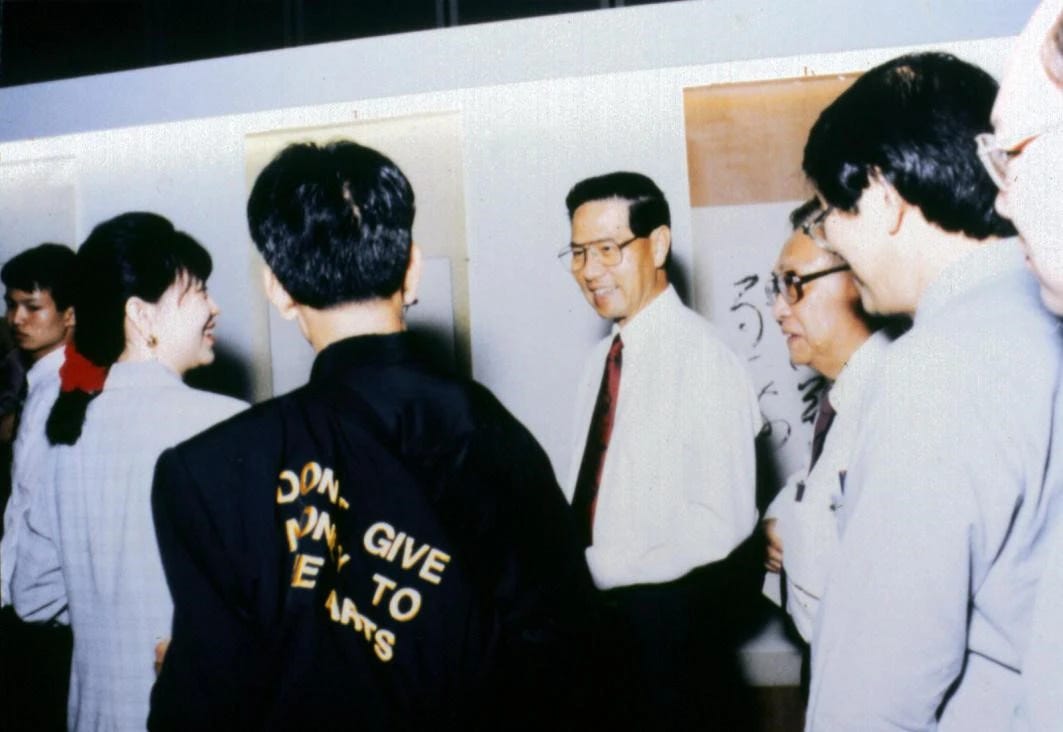
After the event, a reporter asked Tang about the intention behind his performance, to which the artist explained that he wanted to let the President know that public money was being used to fund “the wrong kind of art.”
Goh, Wei Hao. "Performing Uninvited: Tang Da Wu and Don't Give Money to the Arts." National Gallery Singapore, 28 July 2020. Source
The incompatibility that I would like to address is local infrastructure vs. the Art itself. Singapore’s blind commitment to the strict upholding of legal sanctions and a productivity model that regards art and performance as outputs often ignores the humanity — the reflexivity — in the art-making process, as well as its transformative nature. The state operates on a logic of compliance and efficacy: submit a script, get a licence, produce an outcome. But art does not work that way. Process is slow, uncertain, often illegible. It resists quantification. And when process is disregarded in the name of efficiency, art becomes something else — a product, a commodity, a spectacle. This, more than any single ban or funding cut, is what is ruining art in Singapore.
This is what frustrates me. Institutions—government-funded bodies—invite artists to create or submit ideas, but they do not provide suitable conditions for artists to actually make their work due to a lack of communication or prior understanding of the artistic process. The whole art-making endeavour becomes an exercise in compromise and compliance, and the final result could be an artwork that the artist did not desire to make in the first place—watered down to the most basic of outcomes, a mere exercise in "just get it done." Some artists have managed to circumvent this by making these obstacles a part of the artwork itself, but not everyone is so lucky—or so interested in making art about not being able to make art. There is also a need for higher respect and consideration for artists. When an artist or group is invited to create work within an institution's space, they enter as guests and collaborators, and in such situations, artists should feel supported, protected, and able to rely on the institution—especially when inevitable challenges arise. Some artists, perhaps, have never worked with an institution before, and the institutions are seduced, excited, and curious about the untenable, "uninstitutional," "raw," and "grassroots" nature of our work. For example, when an institution seeks to have a rave on their premises but finds the behaviour of rave-goers difficult or the logistics of throwing a rave problematic, it raises a fundamental question: if the institution is unable to hold space for the very underground spaces they wish to co-opt, capitalise on, or program, then perhaps they do not deserve those spaces at all.
On the other hand, before I get into the meat of this writing: artists must also provide good conditions for institutions to support you. First, meet deadlines (if not unreasonable). Second, send things over when they are needed. An artist who cannot send their bio and a simple photograph on time is unprofessional and not on top of their shit—this is a given and maybe reads harsh, but honestly. Third, communicate your needs clearly so that they can be met and the institution can be accountable for them. If you can do these three things or even two out of the three, a lot of the work is already completed. That is my two cents. Now back to the problems at hand.
The first issue, which is the one that drives me crazy, especially as someone who is used to the immediacy and lets get it done aspect of DIY culture, is entirely to do with red tape, capacity and workflow — this is solvable, yet somehow seems to always repeat itself across various arts organizations in Singapore. Specifically, I am referring to oftentimes lack of internal communication and unfair distribution of labour. Many are freelancers and are oftentimes dropped into a project by the time the project is already in shambles from mismanagement. Staff across departments are often also stretched thin, reflecting a broader disregard for arts workers in Singapore, and internal communication between teams is rarely aligned. While we empathise with overworked staff, this misalignment is frequently felt at the artist-facing level, where responsibility, authority, and boundaries become unclear.
A lack of flexibility from personnel in service of beauracracy also makes the creation process feel adversarial rather than collaborative, and artists should not be placed in a position where they must repeatedly defend or justify their work to different arms of the same institution, particularly after an invitation to create has already been extended. In addition, last-minute announcements and shifting conditions—where key decisions and constraints are communicated very late in the process, including limitations around what artists can and cannot do—create unnecessary stress and restrict artists' ability to plan responsibly, particularly for those working with tight timelines, bodies, and limited resources, where late changes can have cascading effects that are difficult to recover from. And because this breakdown means no one is accountable, gaslighting inevitably follows—where artists are made to feel like the problem, rather than the system that failed them.
In spite of all this, we must also remember that arts workers are also collateral within a broken system, and the rigid bureaucratic visions across larger organisations affect how they have to treat and interface with artists, perpetuating a cycle where both parties bear the costs of institutional dysfunction. We must be kind to the people who are part of the same ecosystem as us. These are not insurmountable problems—a little bit of transparency, timely and honest communication, designated point-persons for artists to liaise with, and clearer internal protocols for decision-making could go a long way in resolving them. I often wonder, what can be done to improve this, so that collectively we do not perpetuate an environment of toxicity and greater resentment.
The second issue is censorship—both historical and ongoing—the culling of the creative impulse. The 1994 ban on funding, whereby the National Arts Council (NAC) completely stopped awarding financial grants to any performance art projects, now constitutes an inherited intergenerational trauma that persists today, even though the ban was officially lifted in 2003. Even now, artists self-censor because they know that certain content or expressions—criticism of the state, depictions of race or religion outside state narratives, and alternative sexualities—will get them into trouble, endanger their funding, their opportunities, or, worse, invite social judgement from their peers.
Basically, waiting for a grant to make your work is a death sentence, because by then you would have lost the artistic libido. A lot of my friends—the ones who are privileged enough or determined and irritated enough—often fund their work out of pocket. After all, it is easier to pay for your own work than to fill in twenty pages of paperwork (ballpark).
Social judgement. Sometimes it is not the government that is the only antagonist in this scenario. A colleague recently said to me: “It just takes one stupid person...” What she meant was: it just takes one member of the public to call and complain, and you’re done for. The Singapore government has always prioritised the maintenance of public order and propriety. While conservatism is often attributed to religious groups and the general non-arts public—constituencies the state is reluctant to offend—the baseline of conservatism is a direct result of the state's own preventive measures, which cultivate an air of caution. Singapore is the petri dish in which this bacterium of fear-based art-making is cultivated, precisely because of the state's hyper-vigilance in preserving the status quo.
That being said, the “one phone call” has never happened. New audiences have met my Butoh collective’s public interventions with curiosity, not rejection. As someone who has been making my own performance work in Singapore by championing an art form that is neither dance or performance art, I have experienced a more complex and, hopefully, optimistic reality. I am grateful that institutions and the people within have recognized its value and made space for this art form to find its place in Singapore. Perhaps the apprehension, while a real condition, is not the whole picture. The public is more ready to be challenged than the system gives them credit for—and programmers, by the very act of gradually programming and platforming such works, already know this. We must not underestimate Singaporeans’ ability to engage with subversive and unfamiliar art. We are more intelligent and open-minded than we are led to believe.
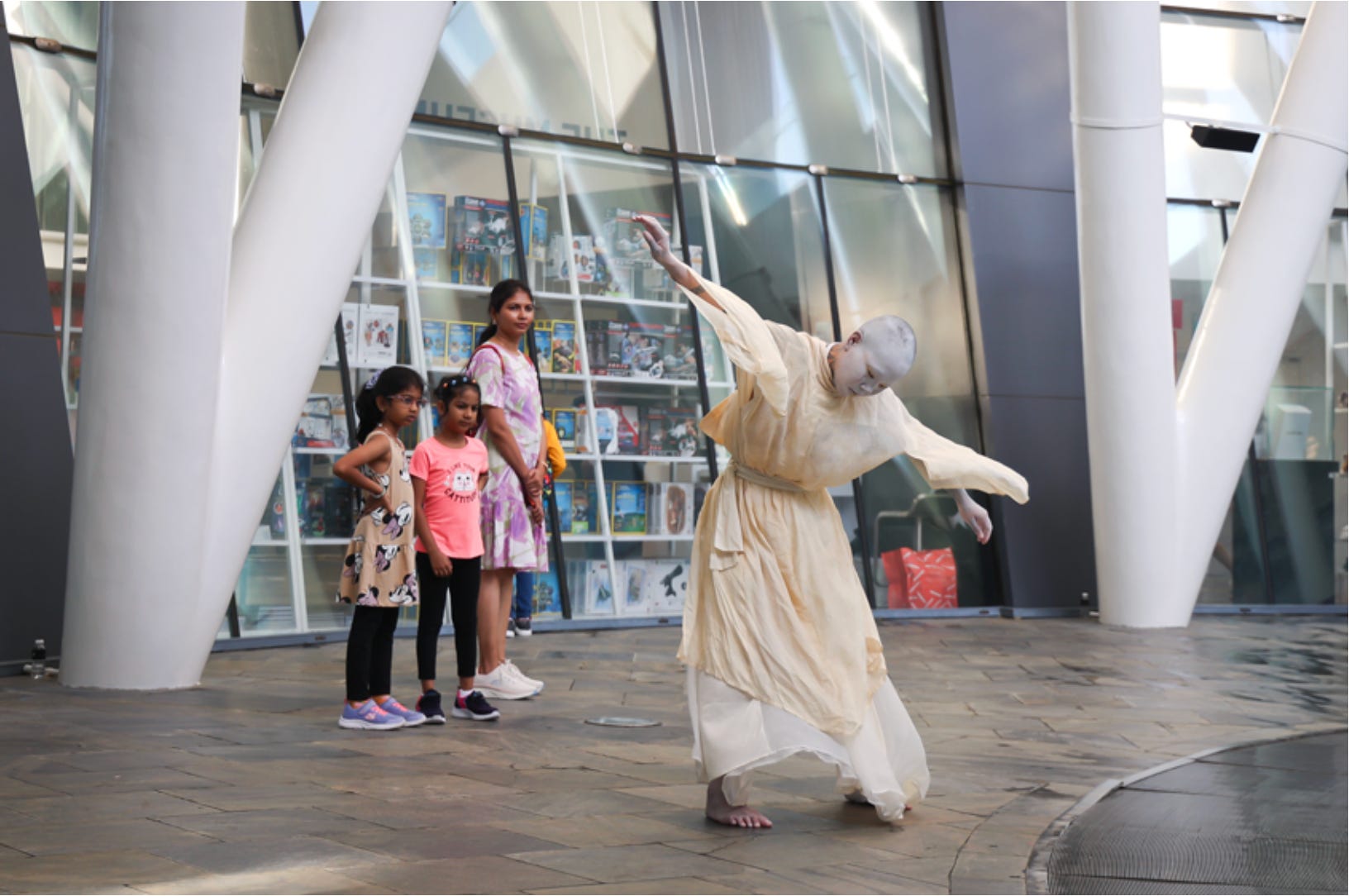
Consider two examples of outdoor public performance. First, a street show organized and curated by *SCAPE, where members of the Singapore Butoh Collective were given the opportunity to dance on Orchard Road. Second, our group's recent performance Cosmic Garden in the outdoor plaza of *SCAPE. In that piece, dancers moved through the shopping mall before performing on the outdoor deck in front of both registered audience members and unsuspecting passersby. By staging the work in the plaza, people were able to access the performance through encounter. By the end of the show, several people shared with us that they had been moved to tears. Some had never seen or heard of Butoh before.
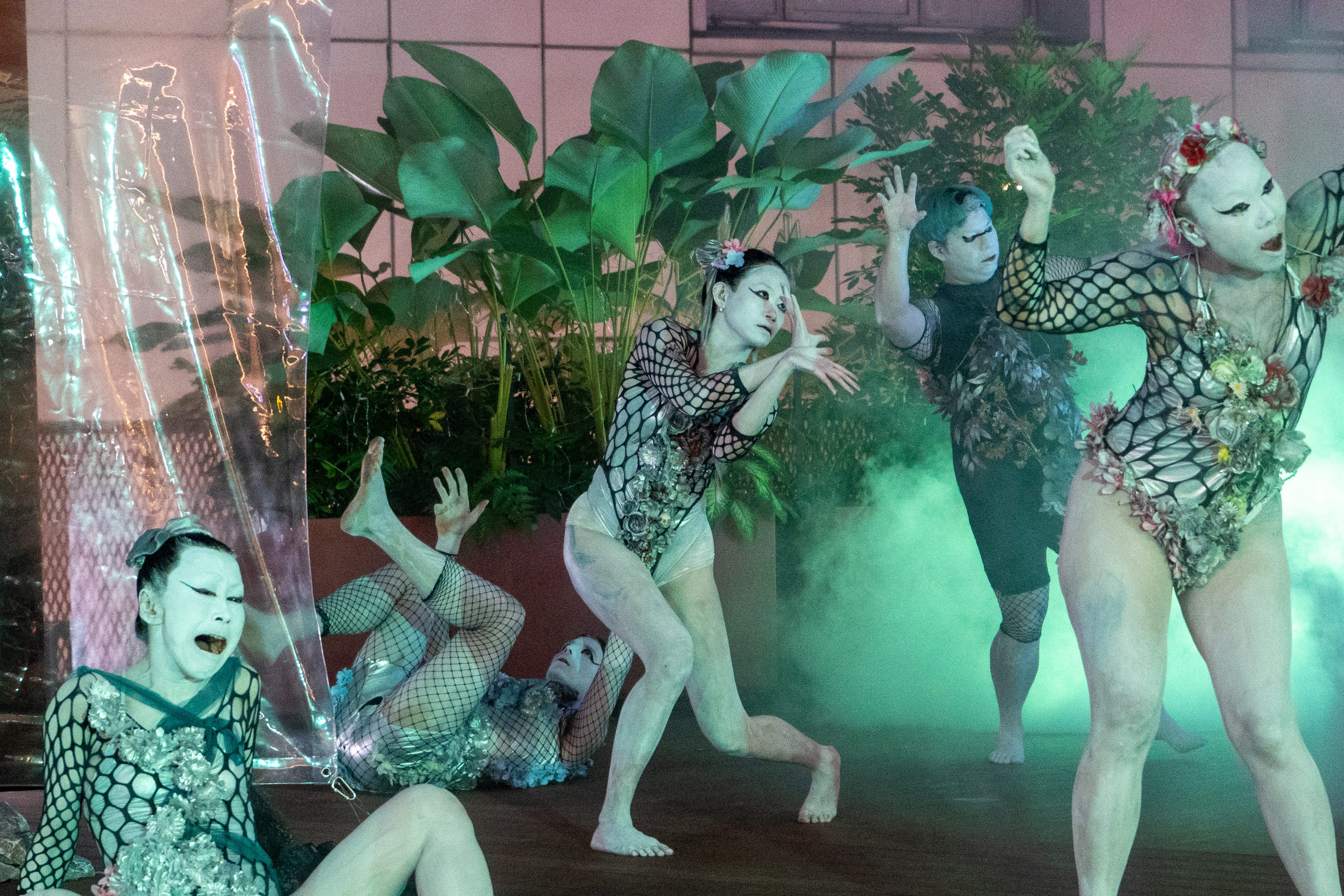
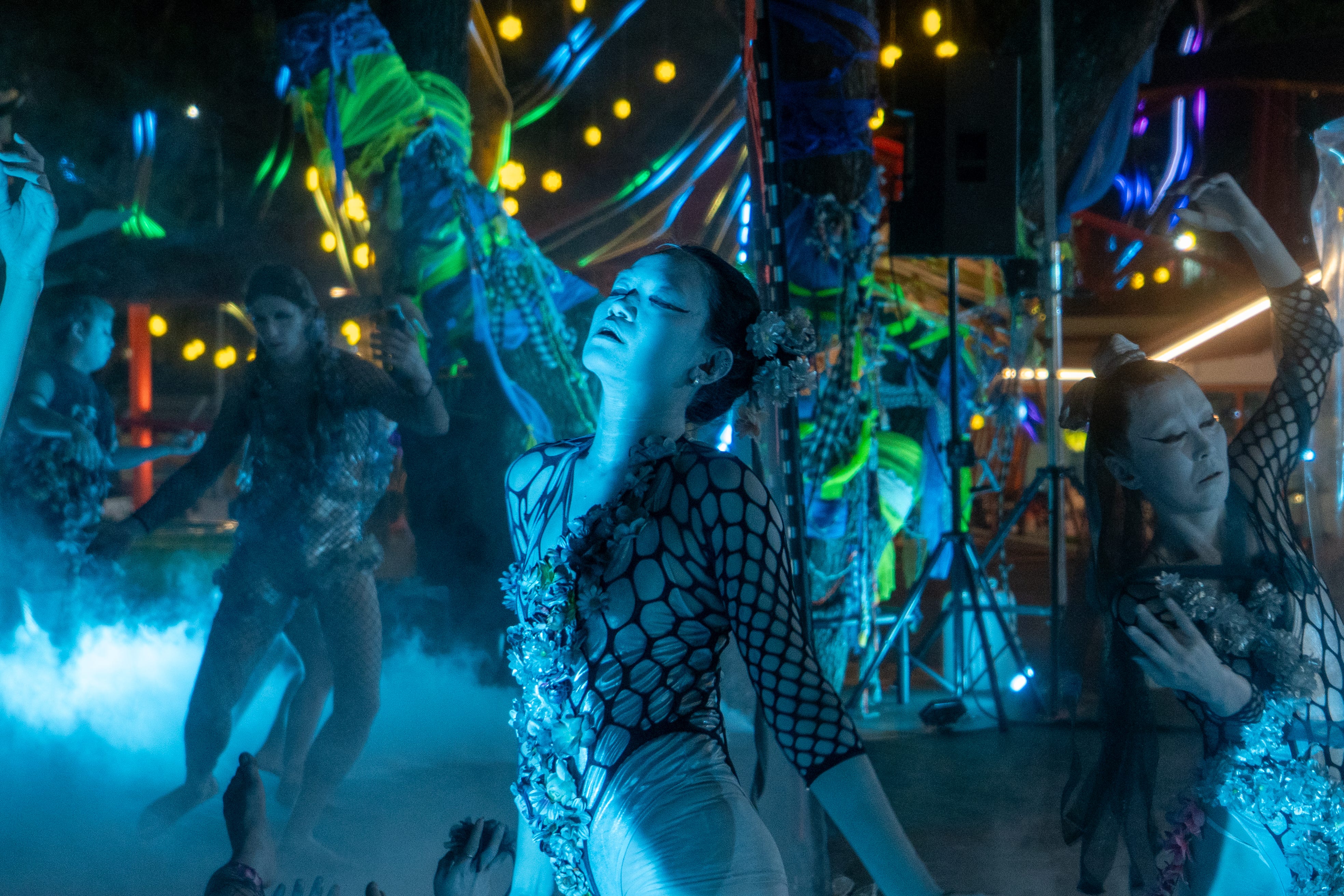
Younger generation artists are also aware of the socio-political significance of being able to perform on the street in a place like Singapore, where a permit is required for all performances in public spaces. Elden Zachery of the Singapore Butoh Collective, performing under the auspices of *SCAPE street show, created a piece ‘freesmoke burningdance’ inspired by the "yellow box" in Singapore. The yellow boxes are designated smoking areas painted on the ground—small, controlled zones where the state permits a legal activity. In his performance, Elden eventually ran amok along Orchard Road and up an escalator, physically breaking out of the logic of the yellow box. His act rejected the state-drawn boundaries on behaviour, using the highly commercial and regulated space of Orchard Road as his stage. I doubt this performance will easily happen again, but I am glad he seized the opportunity to test some boundaries.


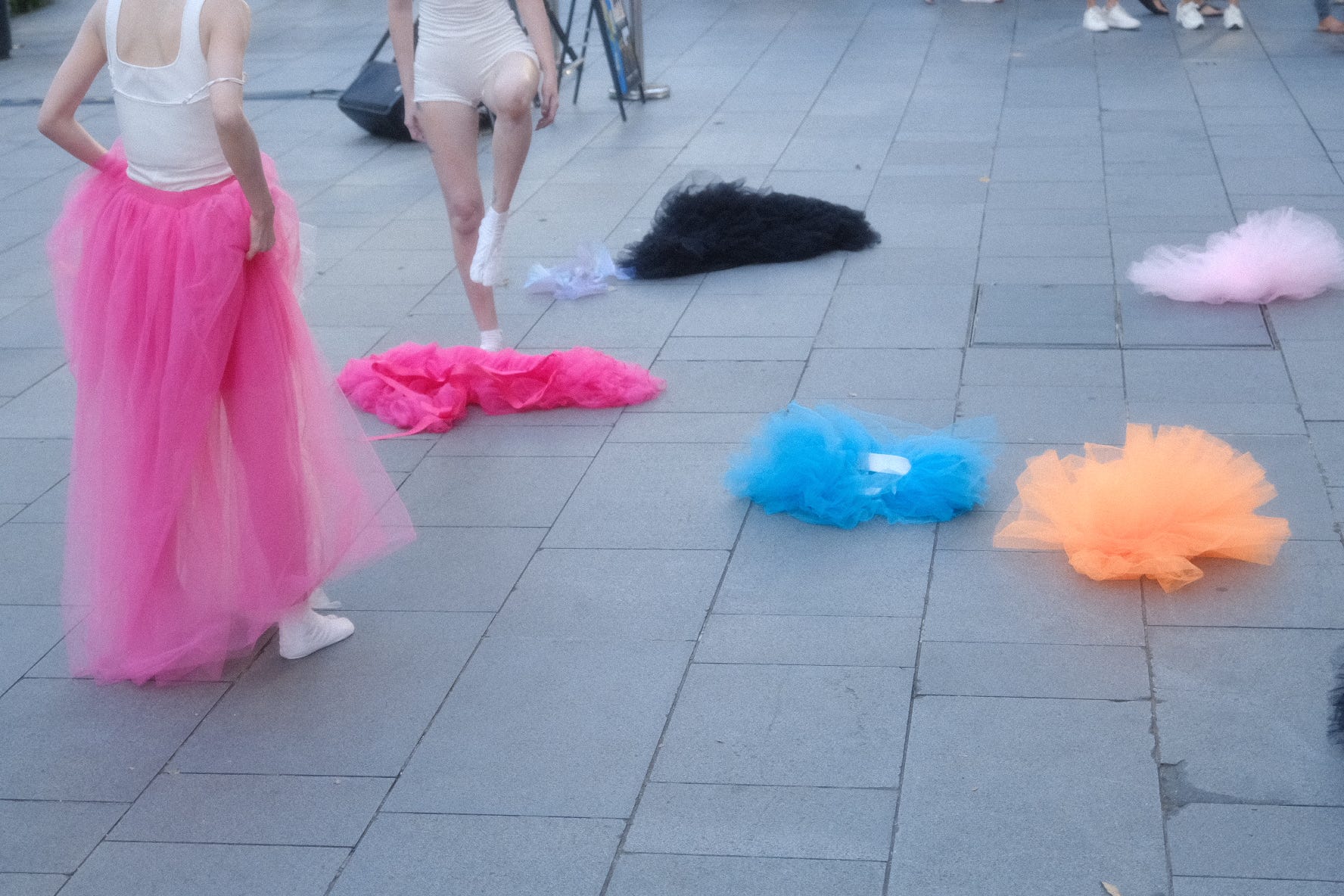
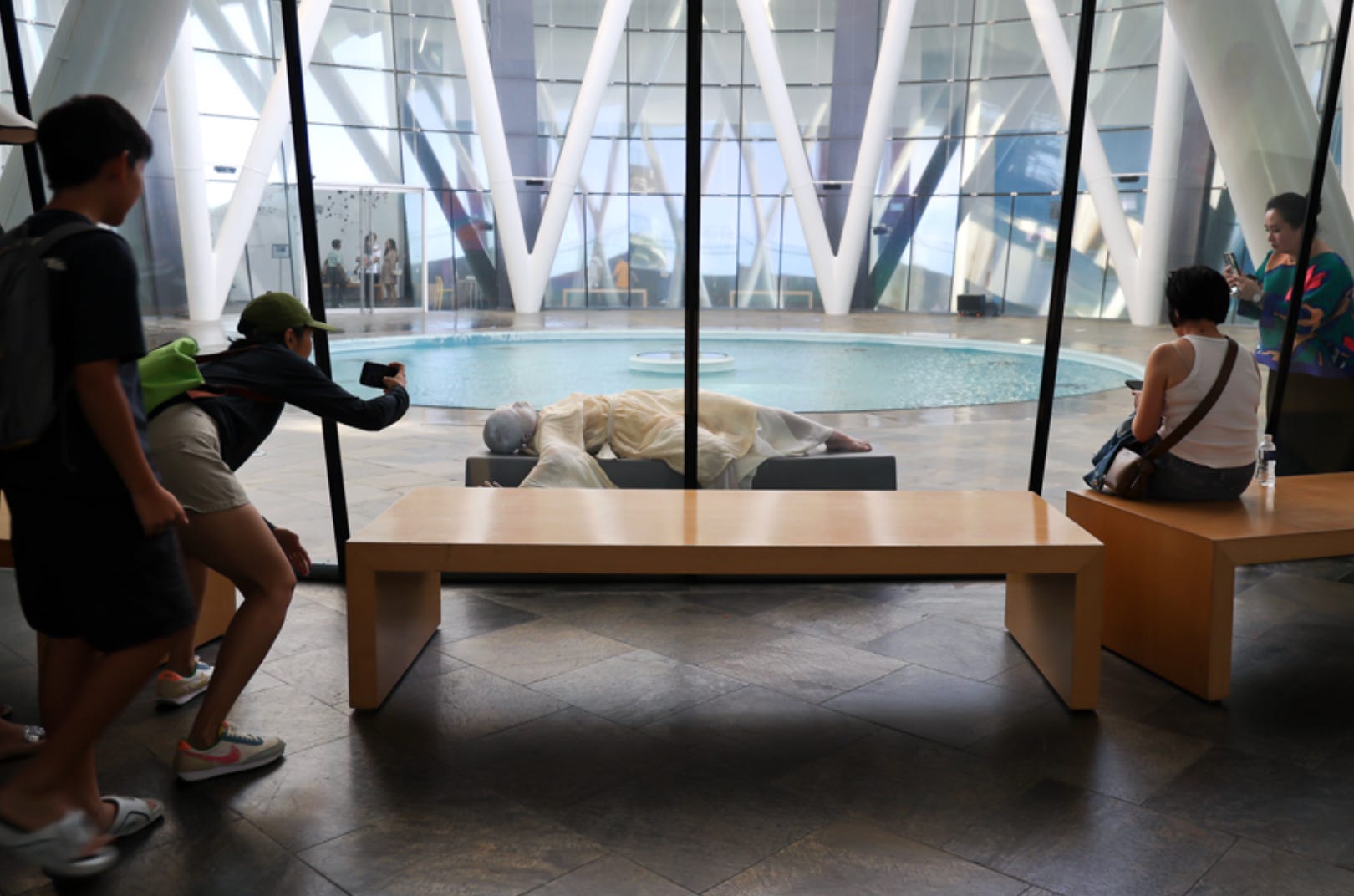
Consider my eleven-hour performance at the ArtScience Museum, where members of the public were initially unsettled by my presence but then stayed. I remember an instance where a man was mocking me out of discomfort, and his friend glared at him so hard I could feel his shame. Consider my recent performance at the Esplanade concourse—an area dense with concert-goers and members of the public in various trajectories—with ruan player Neil Chua, where aunties took selfies with me and people seemed more intrigued than perturbed.
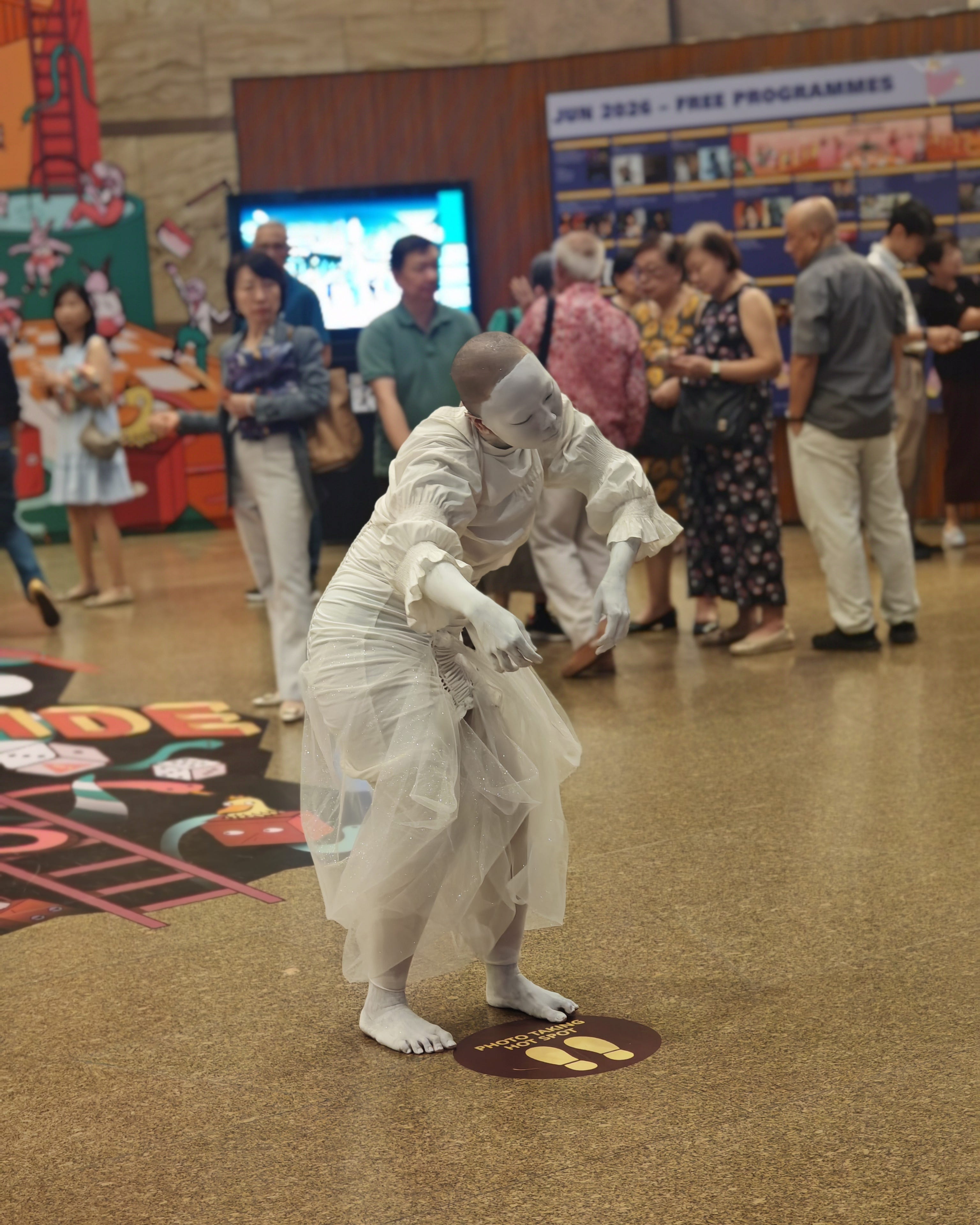
Unlike performance artists of the past, who perhaps leaned more into the antagonistic politics of the avant-garde, I am not setting fire to things, playing with my bodily fluids, or wielding knives. I am merely dancing Butoh—which I also consider a form of performance art. And yet, to paint my body white and move in ways that do not resemble conventional forms of dance already provokes a certain apprehension or mistrust in present-day Singapore. The fear is not ignorance. It is a learned response to a system that has historically punished transgression—even when that transgression is as gentle as a white body moving slowly in space.
The challenge is how we as a society respond to such works — with vitriol and calls for the revoking of state funding, or with mature and measured debate.
Hoe, Su Fern. “The Art of Govt Funding Still a Work in Progress.” Channel NewsAsia, 3 Aug. 2017, www.channelnewsasia.com/today/voices/art-govt-funding-still-work-in-progress-5560471.
The third problem is funding. In Singapore, it is hard to put money in something you cannot predict or control. State and private institutions operate on a logic and operational structure fundamentally incompatible with live art—or any artistic practice not inextricably tied to capitalist modes of production. They demand hard metrics, the dreaded (KPI) Key Performance Indicators: tickets sold, media impressions, audience demographics, outcomes that can be reported upward and monetised. Art that resists quantification—performance art, sound art, research-based practice, interdisciplinary work, conceptual art, butoh, or any practice that fails productively, categorically, or leaves no material or moral trace—oftentimes need to make a stronger case as to why they have value. A related dimension is mass appeal. Art for the masses, under this framework, necessitates that art become a commodity or be rendered “family-friendly” or entertaining for the public. The result is art spoon fed to the “average Singaporean” in ways that they can understand easily. Yet does the state need to infantilise its citizens to such an extent that it no longer believes them capable of independent thought or criticality? Is this not, in fact, the very purpose of art—to provoke higher learning and liberation, to help people see outside themselves and enter into new perspectives and challenge old belief systems?
In Singapore, we face much bureaucratic difficulties in organizing "Performance Art". Some artists have denied describing themselves as performance artists due to this difficulty, or changed their practice into dance or experimental theatre instead. I started using the words "I am not a Performance Artist", in response to this situation and led this on to the need to question and re-position the natural rationale and philosophy of anyone's art practice. The performances were meditations on the various questions on art such as what constitutes a work of art? Or, why we should make art at all? And serve as a starting point for various other discussions.
From a post on the artist’s website, undated. (Lee Wen)
Tan, A. (2020). The artist speaks: Lee Wen (B. Quek, Ed.). National Gallery Singapore.
The fourth problem is academia. Singapore's arts schools produce graduates who can name-drop famous artists and write essays laden with theoretical jargon (like me), yet have no idea how to apply for a grant, document or light their own work, rent a space, or organise a DIY event. Tragically, others emerge capable of neither.
Underpinning this dynamic is the assumption that education—learnedness, literacy—is the prerequisite for success, and that it must be bestowed by the institution. Theory disembodied from practice is noise. Education unaccompanied by care or understanding is simply another form of contempt. This produces an individual that is highly literate but vapid: capable of the appearance of critique but incapable of honest self-reflection.
Meanwhile, the National Arts Council's grant structures also demand a specific kind of writing—and a lot of it, along with detailed budgets. Work also stands a better chance of funding if it possesses a "cultural purpose"—an expectation and framing that reveals a deeper problematic within the state's understanding and framing of culture. The implicit demand is that art serve certain accepted narratives. But what happens when an artist has no interest in being a spokesperson but rather an instigator or meanderer? What happens when the work engages race or religion precisely in order to challenge them? What, then, of art that refuses clean categories? Where do those types of art go? Oftentimes, applicants will then receive an email requesting clarification after submitting a proposal, only to be ghosted thereafter after answering a slew of questions. This is the problem. More and more, we are given templates for how to do things. And if the work does not fit into that template, it goes nowhere. Nowhere does the curriculum address how to write a grant application that articulates a vision that falls outside the state's frame of understanding.
Our current racial and religious harmony didn’t fall ready made from the sky. We engineered this over many decades. People accuse us of ‘social engineering’. So what? i ask” (K. Shanmugam, 2017)
Abdullah, Walid Jumblatt. Why Palestine?: Reflections from Singapore. Ethos Books, 2025
Attrition begins here, in the schools and educational bodies. Students who do not fit the institutional framework—due to divergent ways of artmaking or being unable to communicate their ideas with clarity—eventually drop out. They leave feeling misunderstood or condescended to by advisors, or convinced that their work is simply not institutional enough for the institution. Many abandon their dreams of artmaking altogether. Even among those who persist, there is a pervasive fear of being wrong—a terror of failure that forecloses experimentation before it can begin.
“I don’t wait for curators to pick me, I create my own opportunities.”
Affirmations for Artists - The Artists’ Institute for Quantum Kinship by Salty Thunder and Tan Kia Yee at double space as part of SG Art Week, 2026
“I am vast enough to house my biggest artistic visions.
Affirmations for Artists - The Artists’ Institute for Quantum Kinship by Salty Thunder and Tan Kia Yee at double space as part of SG Art Week, 2026
The fifth problem is attrition. Artists leave. This is a fact. The process is gradual, a slow burning fatigue—they simply stop engaging, stop applying, stop making, stop showing up and sometimes even leave the country. The system does not notice because it never accounted for them in the first place. Each departure is a small death, after a point, I fear that when everyone is tired, art in Singapore will be difficult to resurrect. These problems are not new to anyone. Me writing this is not merely me exercising my national right and affinity to complain, although I have admittedly done my fair share of it.
This is a call for redesign; of a system that was not designed with us in mind, even though it claims to be for us. I also recognise that many artists from preceding generations have engaged with this frustration long before I sat down to write this text; I am merely picking up where they left off—in defiance of attrition and to put my mouth where I make my money.
Radicalism and the Singaporean Avant-Garde: Vomit, Piss & Pubic Hair
Who was in the system before us? Who set the precedents for resistance and radical artmaking? The answer (to my current knowledge) lies in the early experimental artists of the 1970s and 1980s. In 1979, Tang Da Wu created Earth Work, a series of site-specific pieces made in a Sembawang construction site slated for redevelopment, where he hung linen sheets in muddy gullies and slapped mud onto wooden planks. When the National Museum Art Gallery exhibited these works, the director shut the exhibition down after three days, complaining that "earth and lumps of clay shouldn't be in the museum."1 Tang was undeterred. In 1980, he successfully reopened the exhibition at a different venue.2
Sidebar: In 2025, a venue pulled out last minute from hosting a performance night by my collective, citing poor ticket sales and revealing a troubling expectation that my collective could “promise numbers” that I was personally not aware of having agreed to. A few days later, we staged the show at an alternate space run by friends. Many people from our community showed up, buying tickets at the door — our usual modus operandi, as we usually operate on a model of trust.
This incident revealed to me that in Singapore, not everyone who offers space is trying to give you a home or a safe space nor do they do their research before approaching you to do things. Often, the dynamic is more parasitic or exploitative. Our collective enjoys a robust social media presence and following, but it is not a commodity to be monetized or profited from, nor is anyone entitled to that. The attempt to capitalize on this — to turn community into currency — is, unfortunately, not uncommon across most institutional or commercial art entities.
My point is this: artists have been fighting for a long time to do things that seem unreasonable or pointless to others—because we see the value that others do not. No dirt in the museum? No problem, lets move the show elsewhere where things can get messy. Staging a Butoh night with multiple performers and low ticket sales? Would the dancers still dance? Yes. Nobody is doing it for the money, because we have never trusted the system to pay us properly or on time. We also don't rely on or pressure our communities to pay us; often, they are also made up of other artists who are experiencing similar difficulties. What we do do is try to inspire each other to continue and to create more by selflessly sharing our art with one another. This is how we survive in spite of our adversities. Passion and resilience.
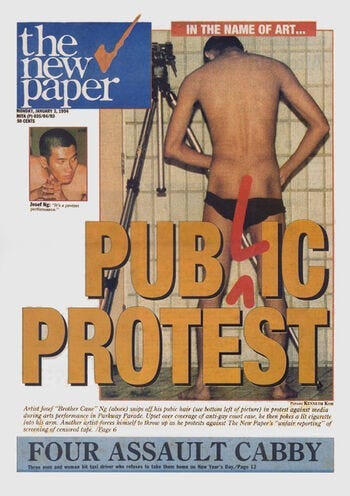
How did performance art get effectively banned in Singapore? The key event was the Artists' General Assembly (AGA) of 1994—a week-long festival. After the festival, several artists were prosecuted for obscene acts. In the wake of the AGA, the state imposed a ban on performance art funding that lasted nearly a decade. This ban, along with strict licensing rules, was triggered by what the government considered indecent or offensive. As a result, it became very difficult for performance artists to thrive or even make their work. Following the 1994 Brother Cane incident—which I will elaborate more on below—the National Arts Council (NAC) became adamant about not funding performance art. Technically, what was banned was the funding, not the artform itself. Many artists still managed to create work, but under scarce conditions. In practice, the ban acted as a state boycott. The state simply refused to give performance artists their due support as a form of punitive action. Creating a charged climate around performance art, which maybe might have actually felt more urgent and necessary after that.
One of the performances that created a scandal, Brother Cane, a 25-minute work by artist Josef Ng featured the artist snipping his pubic hair and stubbing out a cigarette on his arm to protest the arrests and incarceration of twelve homosexual men the previous year. For this act, he was awarded a lifetime public performance ban by the National Arts Council for committing an act of obscenity and fined for violating the Penal Code. A gold star in the Singapore performance artist hall of fame.
Despite what one might assume would be a largely traumatic experience inflicted by the state, Josef Ng has remained in the art world. Although he was effectively banned from performance art in Singapore—he did not quit working in the arts. After leaving Singapore for almost two decades, he joined Pearl Lam Galleries as its Managing Director in 2025. He left, he continued (albeit in another form) and he survived.
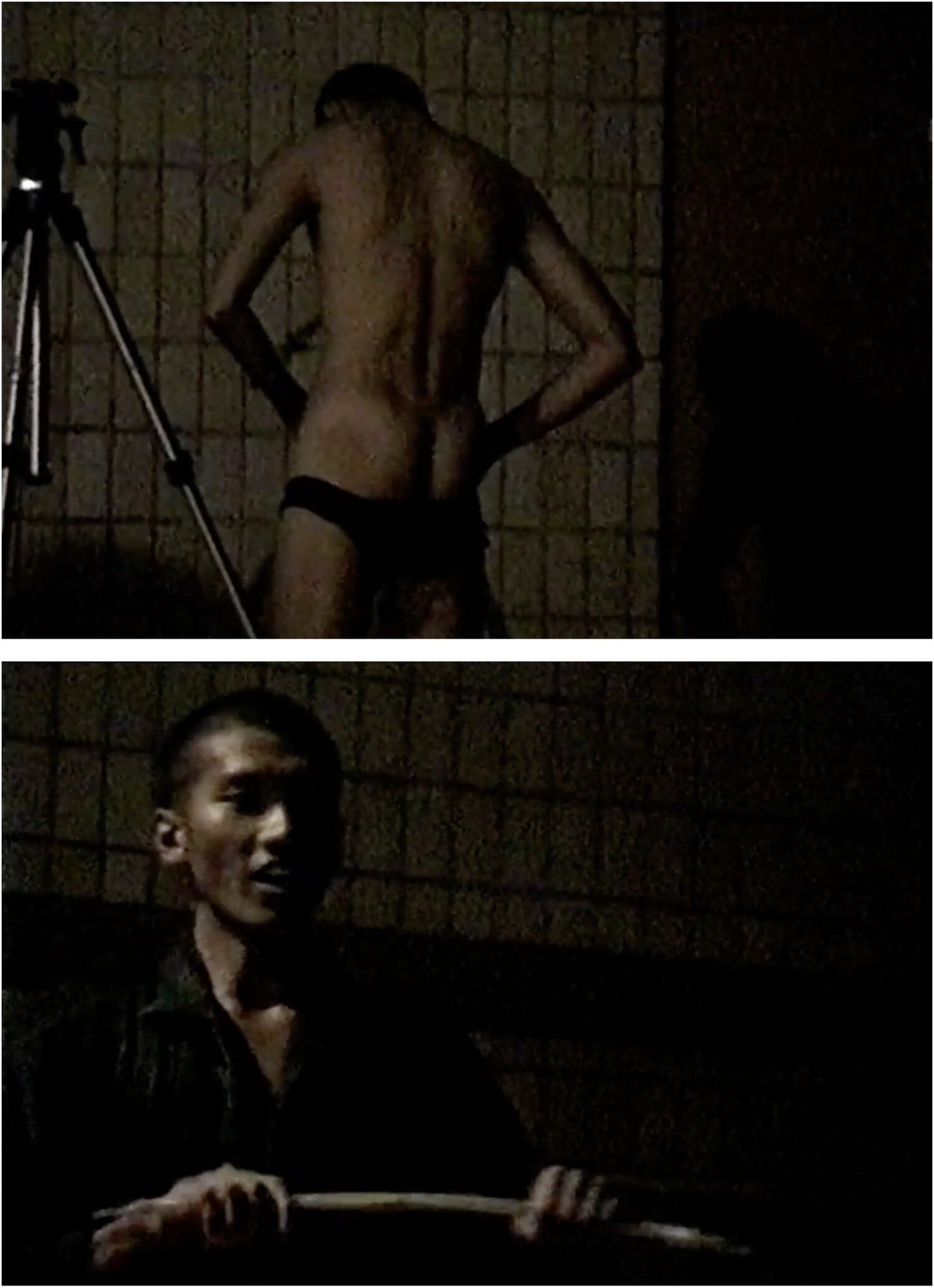
Josef's lawyer said, "He did it for the love of art and in the interest of expanding the general outlook of art in Singapore."
Source
Another artist, Shannon Tham, vomited into a bucket during the same event. These acts caused a major public outcry and resulted in legal charges, as they were considered a menace to the general public.
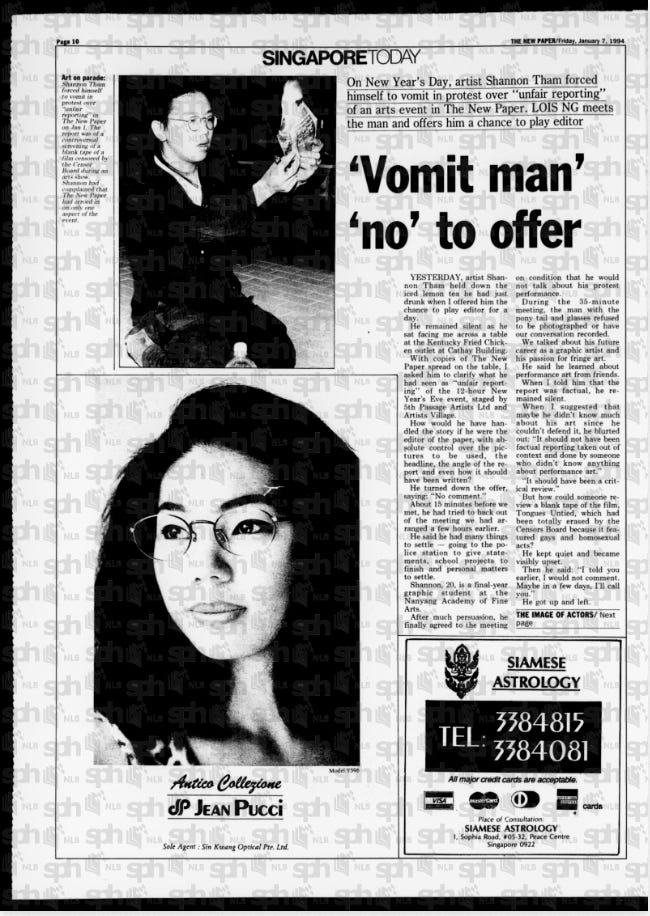
Since the restrictions against performance art have been relaxed in 2003, artists have been required to submit a detailed synopsis, a completed Content Checklist form, and—where available—a rehearsal video or video of past performances in order to obtain an Arts Entertainment Licence or Public Entertainment Licence (PEL). The legacy of the ban was, in essence, an administrative one—death by paperwork.(See IMDA guidelines).
The Future of Imagination (FOI)
Following the lifting of the funding ban on performance art came a festival called Future of Imagination (FOI), fondly recounted to me by George Chua3—one of Singapore's living avant-garde and one of the longstanding independent practising Butoh dancers in the country, and someone with whom I am currently sharing residency space.¹ Talking to George is one of the highlights of my current residency. He brings with him a sense of freedom because he is simply that type of person. Somehow, I find his presence and radical but “matter-of-fact” perspective comforting in the dark sea of my own artmaking process.
Ours is a call to uphold the role and possibilities of “imagination” which is the subject here, and not merely advocate a developmentalist approach to the “future”. “The future of imagination” is a proposition to create a vehicle to take us beyond the turbulent past that put us in the present crisis of contemporary culture into the inconclusive future with artistic imagination presented through live performance art.
Lee Wen's catalogue introduction for FOI 3
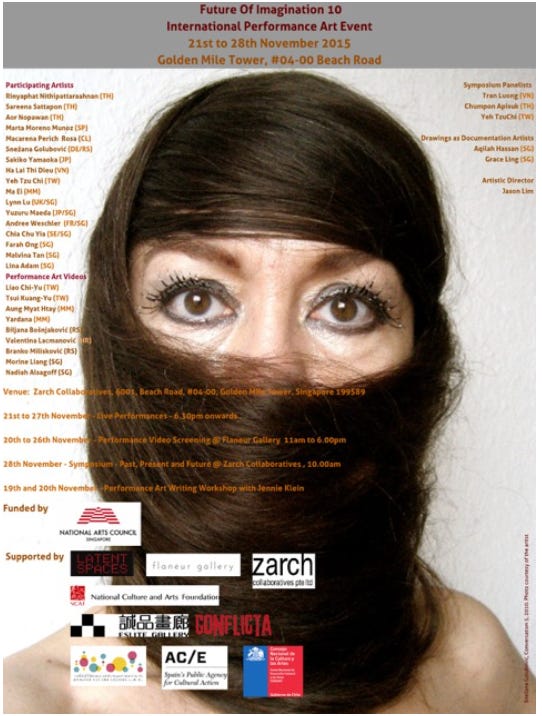
George also performed in this festival. FOI was a time-based performance art event held in Singapore, co-directed by artists Lee Wen and Jason Lim. The festival first took place in 2003 at The Substation, holding ten editions at various venues across the country until it ended in 2015. FOI operated with state and corporate funding yet remained an alternative event for a small international community of artists and audience members committed to avant-garde performance art. In keeping with this ethos, they refused to even sell food or alcohol. The festival’s end in 2015 coincided with the broader decline of independent arts spaces in Singapore, such as The Substation. The festival also came into being around the time that the de facto ban on performance art in Singapore had been lifted, heralding a new era for the form. FOI is a blind spot in my research, as I never attended any of its iterations. Yet the name itself contains perhaps the ethos that I resonate with in the present day: using the artistic imagination as subject—a conduit—into the future. This, I believe, is the purpose of all art.
I mention FOI perhaps as a wish that Singapore would once again hold space for festivals like this—festivals with forward thinking ideals that provided a dedicated platform to push mediums like performance art, which are slowly disappearing in this country. Even if schools like NAFA are cultivating it in their curricula, where do students go to sustain their practice after they graduate or present their work?
I shall Place THE SAnd
Of the words I Wrote
On the Beach Into the Emptied Bottle
Cork it and Throw it Back to Sea to
Tell Them People Not to Come Here
And Please Don’t Save me or do
Anything to help this ISLAND
Payamal, Roy. STREETFOUND: Writings & Images. Edited by Salty Xi Jie Ng, 2021.
An Endless Return?
My friend ila, who takes me on adventures around Singapore as part of her research, told me that the backwash at Punggol Beach brings all castaway trash and debris back to shore. Sometimes I also feel like a piece of trash that got swept back onto the shores of Singapore.
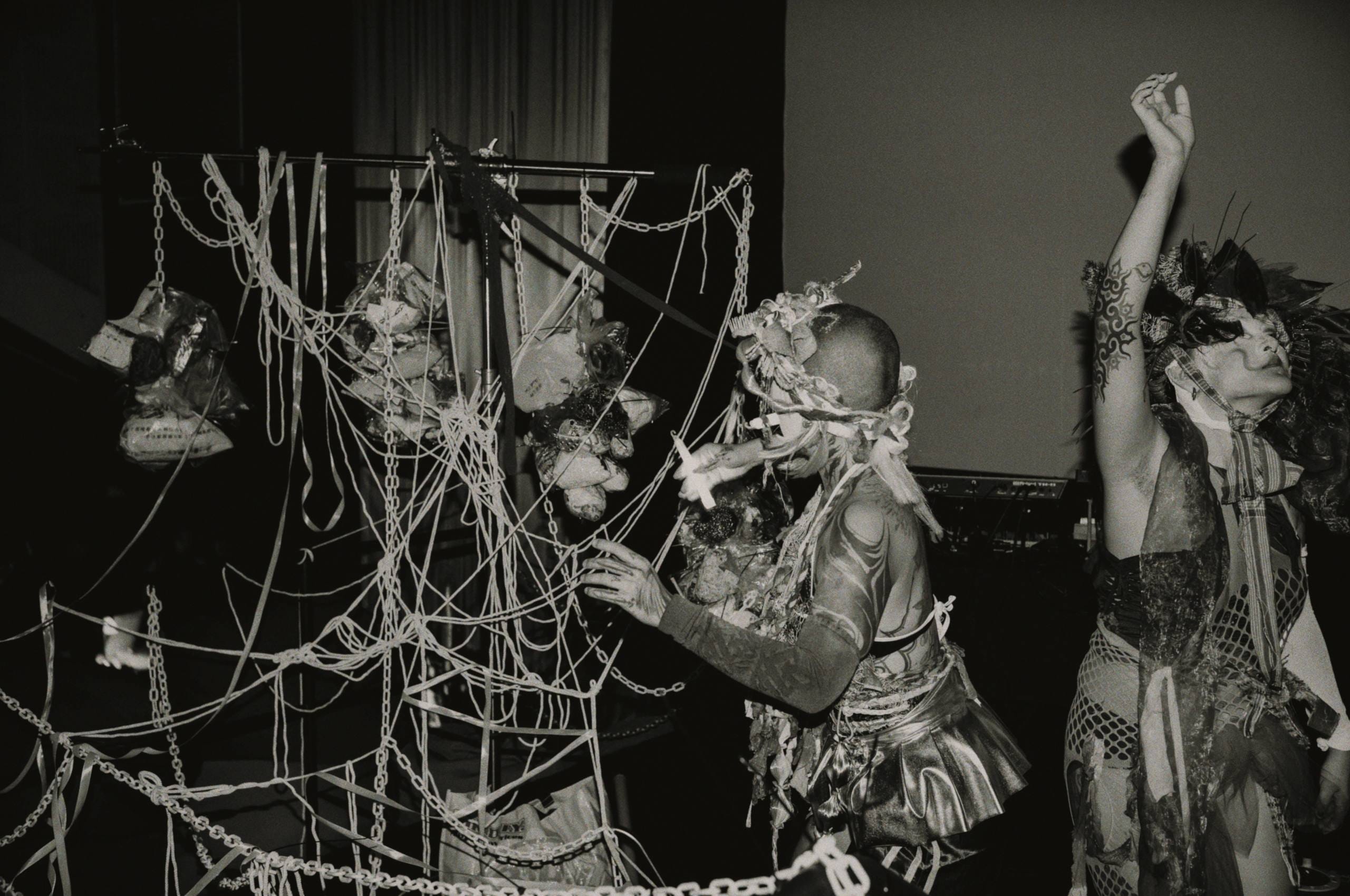
In 2020, I started a regenerative rave experiment called “Endless Return,” now co-helmed by Mervin Wong, Neoliberalarts and myself, inspired by Nietzsche’s concept of Eternal Recurrence; for all the discarded freaks of Singapore. This year we built a set out of literal garbage so that people would be dancing next to actual trash. Amor fati.
Artist Spaces: Past, Present, and Future — A Ground-Up Approach
Upon returning to Singapore in 2019, I started the renegade DIY artist space “RAGA” (2020-2021) with my friend, painter and artist Pallavi, who had also moved back to Singapore from New York. It was to be the first and last studio I would ever have. Brimming with unchecked artistic energy and some rancour at having to return to Singapore for “personal reasons”, we pooled resources to rent a large warehouse space in Macpherson. This space was a “fuck you” space. It was a space that we had complete freedom, in a country that seemed to afford us no agency. It was not a rational decision and put significant financial strain on both of us. Yet we persisted in affording ourselves this expense, as it protected us through the bleakness of the pandemic and against what we deemed the banality of greater Singapore. More importantly, it was not an indulgence but a singular need. We were two artists, sharing a space six times the size of our bedrooms. In this vast space, we channeled and expanded our creative energies into many outlets, we hosted and curated exhibitions, movement jams, and artist dinners, without much intentionality nor thought put into the communal aspect of things. Manifestation occurred through a simple desire: “I want to do this.” This impulse sustained us for approximately two years, until the feeling shifted to “I don’t want to do this anymore” or “I can’t do this anymore.” Things had opened up by then. The pandemic was “over.” Governments globally had decided that it was no longer profitable to try and keep people safe or alive. And thus we gave up the space after its two-year lease and ventured back out into the world.
Out of the community that gathered at RAGA, I founded the Singapore Butoh Collective. I no longer wanted to provide a "hang out" space for artists, but rather a more intentional one: a space in service of experimental art-making, rigorous critical discourse, and the dedicated study of Butoh. This forced a personal reckoning: am I capable of caring for others when I can barely—or have little desire to—care for myself? I had, if anything, a more self-destructive and hedonistic impulse. Artists, I contend, are inherently selfish beings, this is what drives us to make art. Care and accountability are taught value systems; they do not come automatically with the territory of running a space or being surrounded by people who love you. Over time, I came to see that others in the community had quietly stepped into the roles of elder and caretaker—Irving Paul Pereira, Rudi Osman, ila, and so many more. Their quiet care humbled me, revealed the value of wisdom without hierarchy, and gave me healthy role models to emulate—without the pressure of needing to be perfect.
RAGA was my escape, a playground, my first child of sorts. Like a child's first toy—it eventually broke or ran its course. Many things happened there; I met many people. Some are still in my life; some are not. But of all that I remember, what remains, clearly and mostly, is the dancing.


Of course, my friends, collaborators, and I are not the first to attempt running an independent or experimental arts space—though ours happened largely by accident, an itch that just needed to be scratched. Our predecessors include The Artists Village (TAV), Singapore’s first art colony, founded by Tang Da Wu in 1988 after he returned from studies in the UK. TAV was a home for experimental and interdisciplinary practices, a crucible for artists who had no institutional support. At its peak, thirty-five artists lived there, and over fifty more participated in its activities. Everyone worked together openly, with constant overlap of ideas and techniques. The original space was a chicken farm in Ulu Sembawang—until the government repossessed the land in 1990, and the colony ceased to exist as a physical site. Many TAV artists engaged directly with societal changes and political issues during the late 1980s and 1990s. The collective was known for its focus on performance art, installation, and process-based work, playing an instrumental role in introducing these forms to Singapore’s contemporary art scene and pioneering many forms of interdisciplinary intersections.
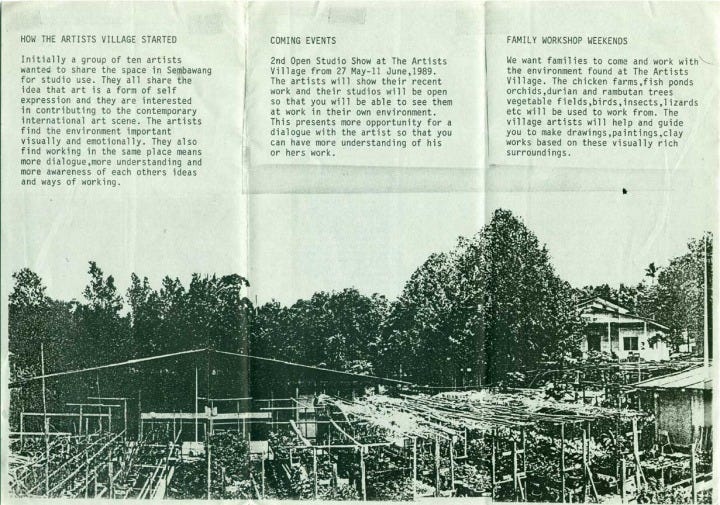
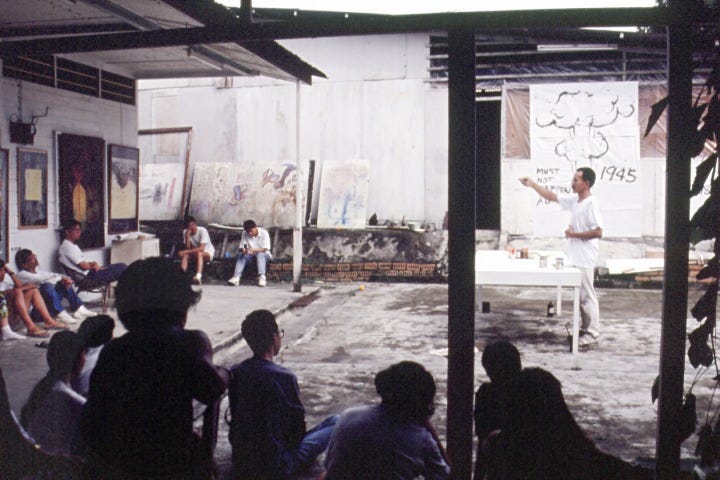
After the land was repossessed, The Artists Village lost its physical space and thus became decentralized. The case of TAV shows that even with state support, true independence and autonomy remains elusive. After registering as a non-profit in 1992, TAV became eligible for National Arts Council (NAC) grants, successfully collaborating with institutions like the National Museum. To receive funding, the collective had to register its members, sacrificing its foundational freedom in favour of state legibility.4 The most effective weapon, however, was control over space. After the government repossessed their Sembawang land in 1990, TAV has been “space-less” since 1992, working nomadically.
If people have a place to congregate, ideas can brew and proliferate. There is space to hone a craft, to fail, to try again. But if the government takes that space away, or if rent hikes make it unaffordable, people have nowhere to go. They eventually stop meeting. Alienation and loneliness sets in. People’s worlds become smaller in an already small city-state.
By managing access to money, space, and legitimacy, the state creates conditions that make a radical, collective spirit impossible to sustain. The struggle of The Artists Village makes this evident. The state’s oldest tactic, after all, is not censorship. It is the fragmentation of power. Consider the subversive roots of also drag and queer culture in this city—practices that have survived through community labour and sacrifice, yet remain in a precarious position when it comes to securing space. Trying to sustain communities means that you are always looking for space.
... [an] alternative venue dedicated to the promotion and encouragement of experimental and alternative arts in Singapore. It endeavors to establish an open space for artists to mature at their own pace, and to provide a conducive environment which allows them to experiment, experience and exchange ideas
Source Quoted in T.K. Sabapathy (1992), The Space: An Introduction, Singapore: Artists Village, p. 1, and in T.K. Sabapathy (1993), “Contemporary Art in Singapore: An Introduction”, in Caroline Turner (ed.), Tradition and Change: Contemporary Art of Asia and the Pacific, Queensland: University of Queensland Press, p. 83 at 86, ISBN 978-0-7022-2583-3
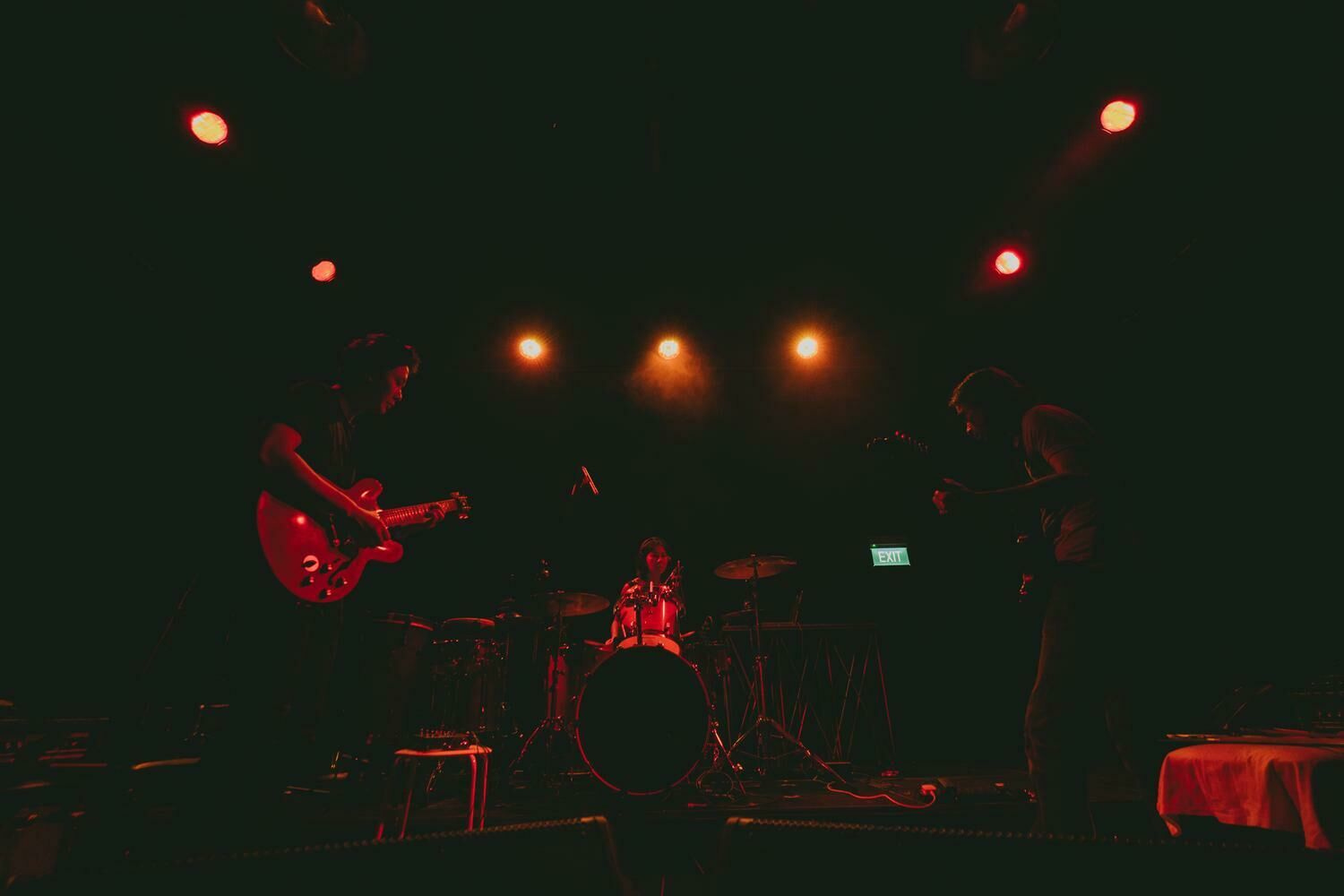
We should not forget the “sanctuary for underground art” founded by theatre veteran Kuo Pao Kun in 1990 as Singapore’s first independent multidisciplinary arts centre. Originally a disused power station, it soon became an underground mainstay and a space for fringe or marginalised works to exist. It hosted not only interdisciplinary artists but also punk communities, queer groups, civil society organisers and weird art shows. It freed people from the demand to produce commercially viable or conventionally polished work. By allowing all these activities to exist, it helped legitimise artistic practices that mainstream institutions had dismissed as unviable or deviant. When The Substation closed in 2021, many people grieved its loss. For me, however, The Substation exists more as myth than memory. A seven-year absence from Singapore meant—I was not involved in its history or cultural fabric. Yet now, in its disappearance, I would consider it a past model for the type of hybrid spaces that needed—and still need—to exist in Singapore: spaces that are now, slowly but surely, dying out.
The closure of The Substation, like many others, was not a single event but the result of long-term precariousness faced by independent arts spaces in Singapore: an inability to survive without outside support, and often an ineligibility for said support, coupled with a disdain for the strings that such support would inevitably attach. This instability is also shaped by cycles of visibility and neglect—characteristic of a country like Singapore, where scenes are small and momentum is hard to sustain for fringe artforms with overlapping communities.
I like to believe that RAGA in its short two years was also a “disruptive” space, a temporary autonomous zone. Many people who passed through our space drew comparisons to The Substation and/or The Artists Village. But the sad reality of RAGA was that it was run by two artists—not people committed to being full-time arts workers nor space managers. The closure of both my own space and the radical arts spaces that came before simply highlights a difficult truth about Singapore—and to some extent, globally—that independent spaces can only ever function provisionally and temporarily in the absence of sustained state support and understanding.
What, if some day or night a demon were to steal after you into your loneliest loneliness and say to you: ‘This life as you now live it and have lived it, you will have to live once more and innumerable times more’ ... Would you not throw yourself down and gnash your teeth and curse the demon who spoke thus? Or have you once experienced a tremendous moment when you would have answered him: ‘You are a god and never have I heard anything more divine.
Friedrich Nietzsche, The Gay Science: With a Prelude in Rhymes and an Appendix of Songs
Butoh: The Dance of Darkness
Butoh, or Ankoku Butoh—the dance of darkness or the dance of the dark soul—emerged in postwar Japan as an avant-garde provocation. It later became a reluctantly codified, sometimes spiritualised, dance or embodiment practice with many branches. I discovered Butoh in my late twenties and soon became obsessed. The form engages and provokes with taboo subjects and the realm of the subconscious. It demands a constant feeding of the imagination through rapid consumption of reality and the surrounding cultural zeitgeist to produce images and sensations which then drive the movement. The founders consumed everything—literature, surrealist paintings, traditional performing arts, modern dance, American pop, European classical music and even phenomena from everyday life. I believe that this avid cannibalisation of all aspects of life is what gives Butoh its power to transcend all boundaries and categories. It is post-post-post-modern. It is everything into nothingness. It is an obliterating dance.
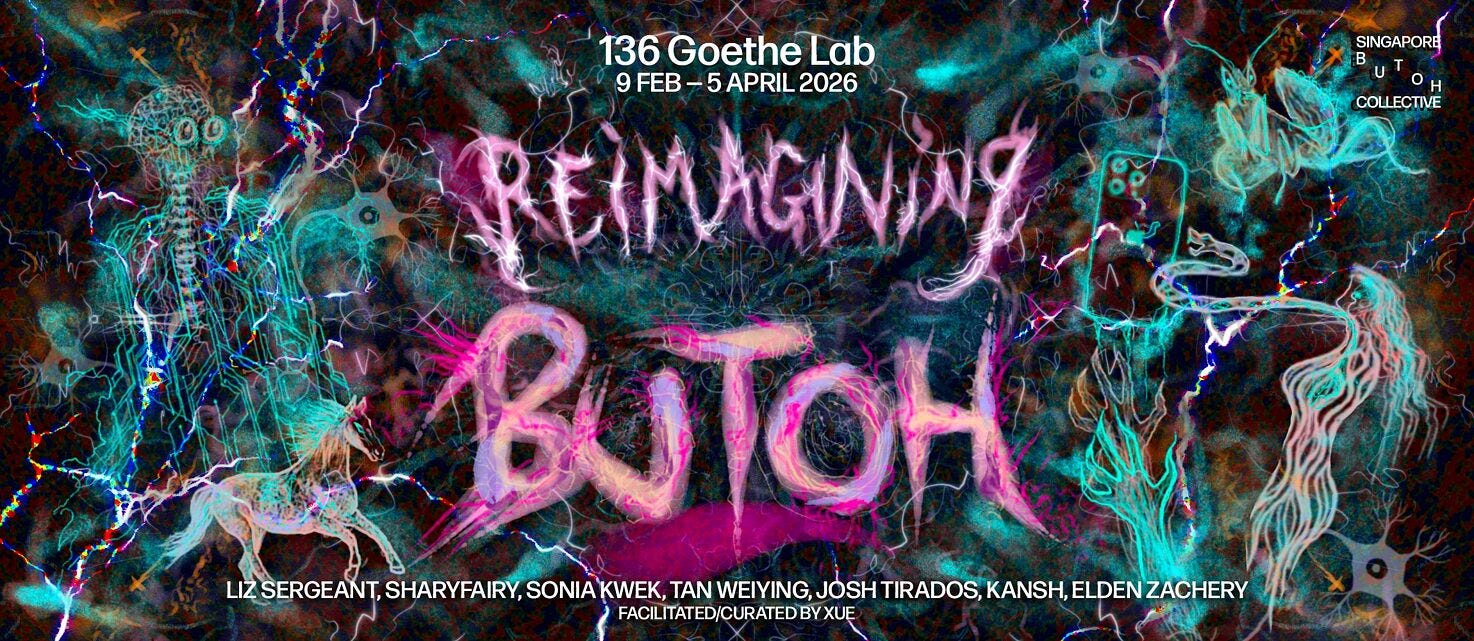
Reimagining Butoh: At 136 Goethe Lab responds to the limited time, space, and structural support available for niche, body-based practices such as Butoh in Singapore. The residency provides emerging members of the Singapore Butoh Collective with dedicated studio access, resources, and a shared research environment to develop interdisciplinary methodologies beyond commercial or pedagogical pressures.
The programme hosts seven members of the Singapore Butoh Collective in a shared, open residency, where divergent practices, ideologies, and influences gather in proximity. The lab functions as a site of research and encounter, supporting sustained experimentation and collective inquiry.
Designed as a temporary home for artistic research, the programme supports diverse entry points into Butoh and encourages artists to experiment, reflect, and refine practices that are locally grounded and collectively informed. Each residency culminates in a small public gesture—such as a research presentation, performance, or performance-lecture—and a workshop, extending individual research into public-facing moments of exchange.
The residency is supported by a temporary Butoh Library and participatory events including discussion circles and film screenings. Supported by the Goethe-Institut as part of the open call programme for 136 Goethe Lab, the project contributes to a more transdisciplinary, critically engaged, and evolving contemporary arts ecosystem in Singapore.
Goethe Institut write up. Source
This year, my collective applied for a Butoh residency at the Goethe-Institut Singapore for their open call, "Reimagining Community." My proposition was "Reimagining Community; Reimagining Butoh," a direct solve to the "limited time, space, and structural support available for niche, body-based practices such as Butoh in Singapore." As I fought for more resources for my collective, I also had to confront how this clashed with my personal politics. By the time I submitted the application, I had told myself I had made peace with some things, but those things always come back to bite you.
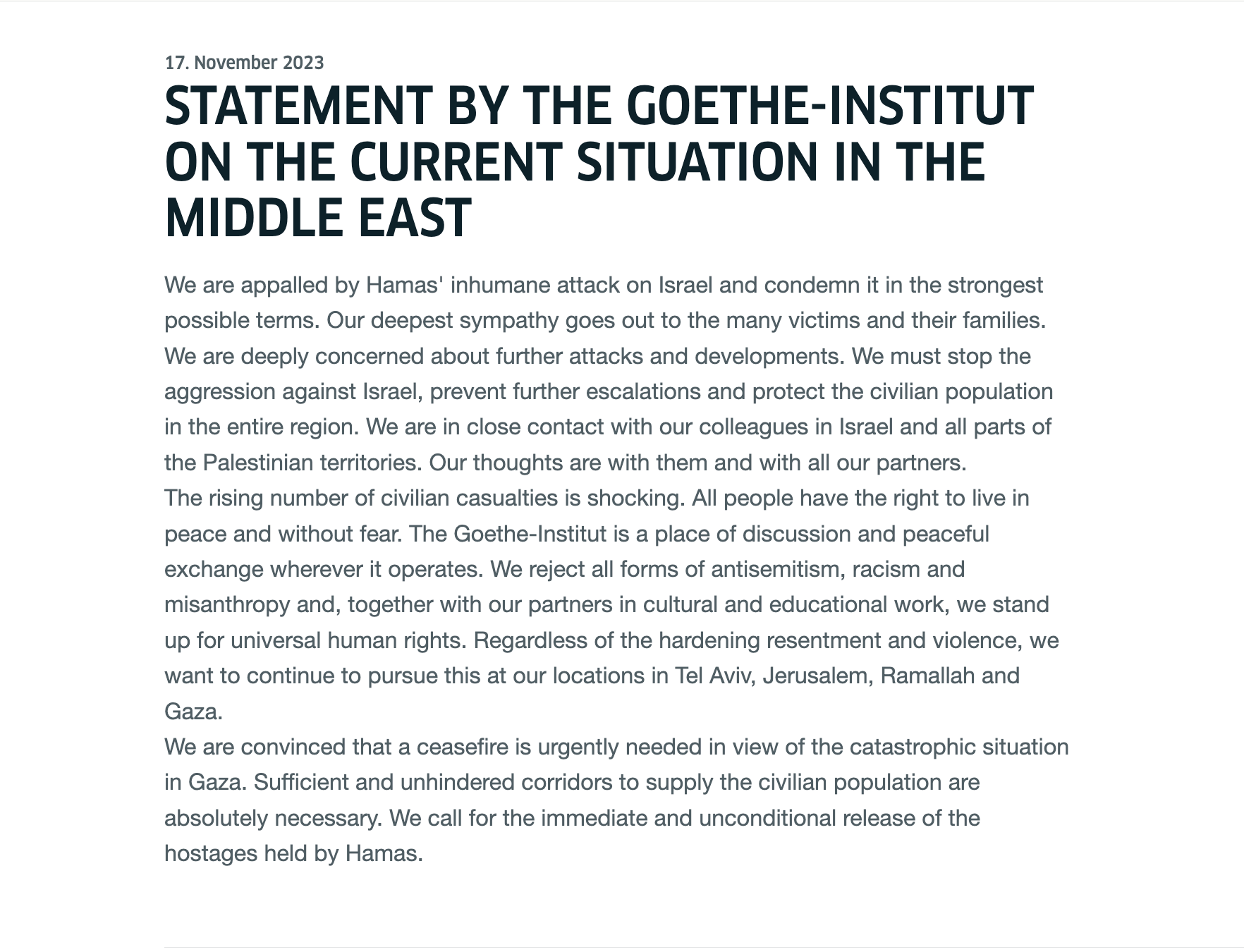
The Goethe-Institut is Germany’s cultural institute, operating globally to promote German language and cultural exchange. On the surface, it is a benign presence: funding artists, hosting exhibitions, facilitating residencies. In Singapore, the Goethe-Institut has been a supporter of experimental and independent art for decades—spaces like The Substation, festivals like M1 Fringe, artists who might not otherwise receive institutional support. But the Goethe-Institut is also a German institution. Since October 2023, Germany has positioned itself as one of the most vocal defenders of Israel's military campaign in Gaza—emphasising Israel's "right to self-defence" and approving over €492 million in arms exports, making it the second-largest supplier after the United States . Statements from German politicians have repeatedly framed criticism of Israel as inherently antisemitic . The cultural sector has been no exception: German-funded festivals have cancelled Palestinian voices, German institutions have withdrawn invitations to artists who speak out , and the Goethe-Institut itself has remained largely silent on the issue of genocide, but some international branches have released statements calling for a ceasefire. (See Archive of Silence)
When my collective was awarded the open call, I found myself in an ethical conundrum. There was pushback from the community—which I take seriously—regarding complicity. So internally, I negotiated a debate. One position: work within, take the resources, push from the inside. The institution will not change due to “cancel culture.” Could our presence be a form of leverage or resistance in itself?
Another option was to rescind the proposal entirely. Boycott. The Goethe-Institut is not a neutral platform. Our labour would be used to launder the reputation of a government that is arming a genocide. Then I thought about Singapore’s own complicity in the war machine, also still maintaining a military relationship with Israel and also enacting its own strict censorship laws against people speaking up against the genocide—Singapore and Germany, both as guilty. If I were to boycott the Goethe-Institut, should I also give up my Singapore citizenship?
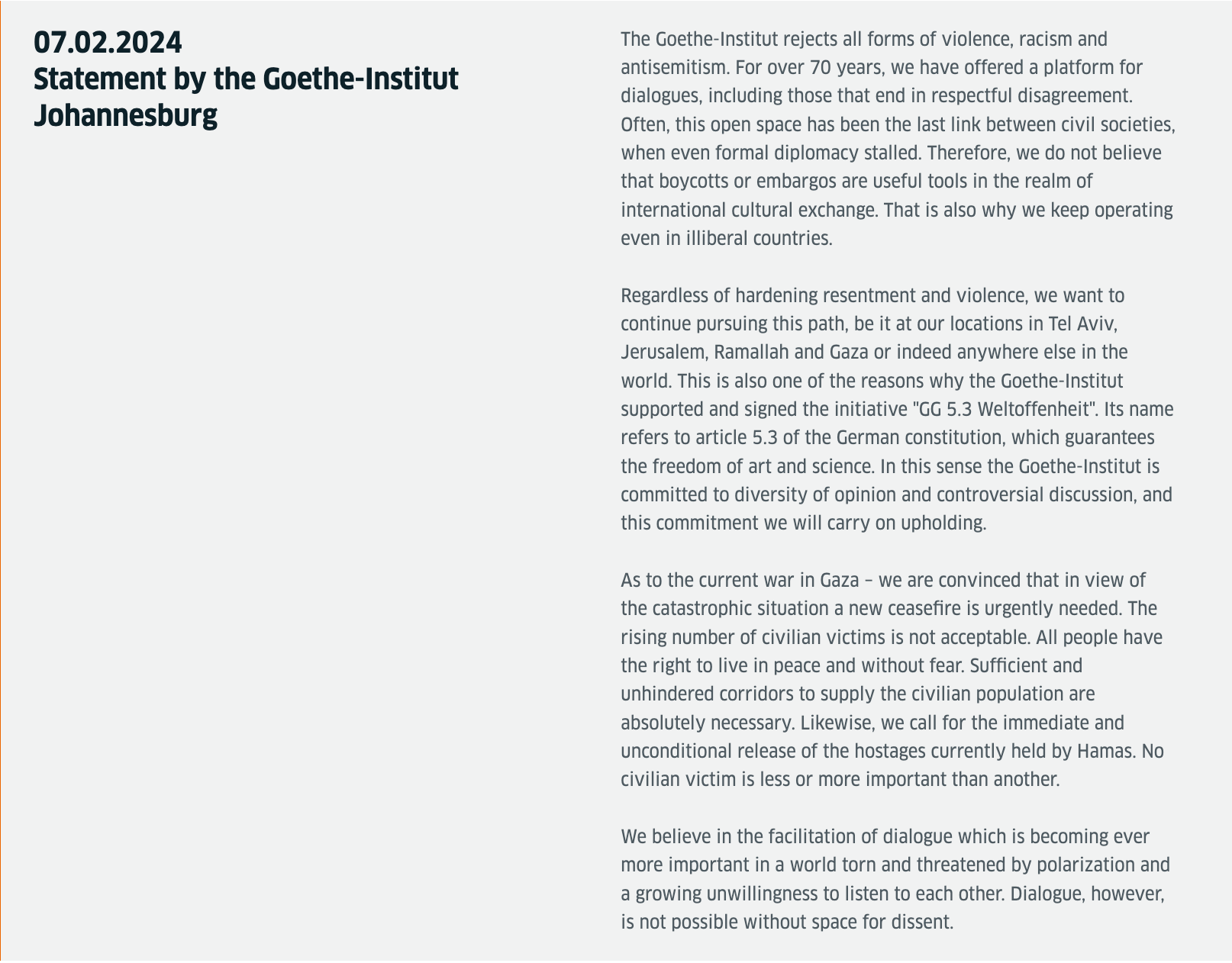
To negotiate this issue, the artists-in-residence and I asked for an internal conversation, for a quick vibe-check, just to get on the same page. Those we met with did engage with us in a sincere and honest way. They were open to critique about the institution’s stance on the Palestinian genocide and about its defensiveness against past letters and artist pushback. There was no sugarcoating of the discomfort of institutional apathy, but also some reality checks and transparency about the limits and personal cost of trying to shift policy from within. What was communicated as the institutional “limit” was this: we were allowed to advocate within the residency, with the only red lines being no extremist statements that denied Israel’s existence and no promotion of violence. Their bottom line was structural: the institution protects itself first.
We made our position clear in return: the Singapore Butoh Collective would set and negotiate our own terms of how to exist within the institution. We stated that we would proceed with the residency, but that we would not self-silence. Residents were able to stand in solidarity with and fight for the Palestinian cause within their own programmes and contributions, and to work in the grey area of residing within the institution. We proceeded on the basis that institutional constraint did not cancel artistic or ethical agency, and that we could try to make a difference within those constraints.
A shared understanding was reached: our collective would maintain full autonomy in defining our resistance while residing within the institution. Two residents raised funds for various initiatives and donated proceeds from their workshops. Some portion of the funding was used to pay for a grant-writing workshop, whose request for payment was essentially to donate the workshop proceeds to Palestine related fundraisers. Until now, I still do not know if what we did was enough. But it is just another compromise I have to sit with.
But to share a bit more about the residency itself and the motivation for applying: the core impetus was to provide artists from the collective with free space to conduct research as they saw fit, free from institutional pressure or pedagogical structures, each artist also received a stipend of $800. A Butoh library—a longtime dream of mine—was installed in the space to give members access to academic readings and resources that would deepen their understanding of this esoteric and often misunderstood art form.
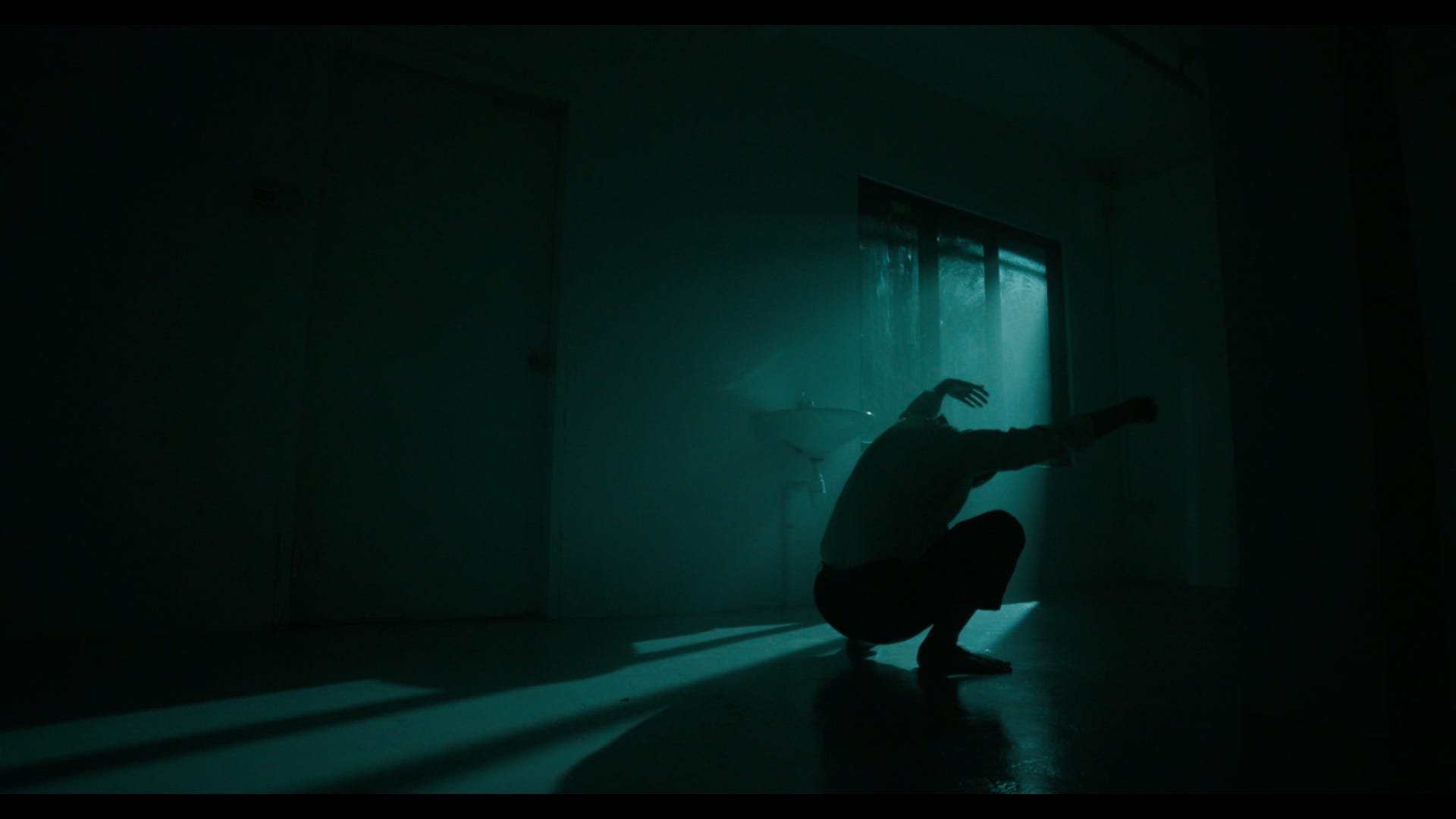
Despite my doubts, we achieved everything we had set out to do and the community turned the space into its own universe. And then something happened that reminded us again of our vulnerability and precarity as a small art collective. A leak appeared in our space, and with it came the smell of sewage from the cafe above. We braved one performance with the leak, incorporating it into the scenography through the good nature of the artist. Yet, despite our efforts, the space eventually proved unusable. With resident showings looming, myself and the other residents reached deep into every resource we had to find new rooms, new locations, new spaces. In the end, the institution offered us their rooftop deck for the last few showings. Open to the sky, it proved far more alive for performance — a blessing at the end of a storm.
Through these adventures, I have been thinking that the real dance of darkness I practice is not Butoh but moral and spiritual accounting — called into question by the administrative and strategic work done in service of my art. It is the duel with the real implications of working with institutions for money: where that money comes from and the people that decide to give it to you. And also the labour of making them understand that perhaps the art I make — because it does not adhere to a single genre or formula, except maybe Butoh as it body practice — is a form that will constantly shift and demand things that even I cannot wholly anticipate. A lot of the time, Institutions are deeply concerned with risk, especially in Singapore when it comes to live art and the body. It was also only early this year that I realised you cannot build a three-metre-high structure without a permit and a few months notice. Something as ephemeral as a performance becomes a legal question of safety and liability. This is what artists have to navigate in addition to budgets that never seem to add up— and we need to find ways to circumvent or master it. This is the dance.
Institutions are not monolithic evils. They are collections of individuals, each with their own agency, constraints, and humanity. To focus only on “the institution” as an abstraction is to miss the real site of change: relationship. To work effectively, one must perform the labour of building trust, good rapport, and mutual understanding with the people inside institutions as well. An institution is just an abstraction. It has no conscience — only the individuals who serve it. Yet a hardline must be drawn when an institution is structurally complicit in ongoing harm, refusing to engage can be a necessary form of accountability. The question is not whether to ever boycott. The question is how to decide, case by case, without losing either your conscience or your capacity for relationship. The real work is knowing if it’s worth sparring and when to walk away.
A project I’m currently working on — the most evasive of all my works, a place we could not name — needs darkness as a material. And yes, that’s been tricky, but we keep going because it’s interesting to work with this material and to fail time and again. But often we are asked: lights on? for audience safety? So here’s what I keep asking myself instead: if the artist asks for dark, but darkness is an impossibility within any institution, do we keep requesting for it?
A previous ask of the work was to keep the theatre door open for the first ten minutes of the performance. In Singapore, where this is considered almost sacrilegious, we managed to make it happen. This speaks to the funny pragmatism of Singapore — leaving a door open is seen as actively throwing away cold air. It’s not just inefficient; it’s almost morally wrong in a culture that prides itself on resource management. It also ruins the conditions of the carefully controlled environment. So opening the door for me in this case has like the same effect as when art is experimental in Singapore.
Acknowledging and making space for darkness is realising that everything and everyone holds a shadow — including yourself. It concerns the manoeuvring of power and who wields it. As an artist and human being, how do you continue to empower or protect yourself and your loved ones — from the macrocosmic senselessness of an unfair world where governments kill people, down to the microcosmic dynamic of artist versus institution? With regard to institutions, how do you operate more collaboratively while also not power-tripping on your own artistic ego and control issues? And ethically, as a world citizen, how do you live with your conscience in thinking about whether art is necessary in a world of greater suffering?
If I die, I may want Want To come back again, And be Born in Singapore, Because I Will miss the food here
A Friend Ask me why some Chinese Burn all those Artifacts when one dies, I said, so That They can enjoy those luxuries in the After life. He said, “don’t Worry Roy, when its your turn, I will burn your Amplifier, your Trishaw, your make-Up and all, so you can continue busking up there.
Payamal, Roy. STREETFOUND: Writings & Images. Edited by Salty Xi Jie Ng, 2021.
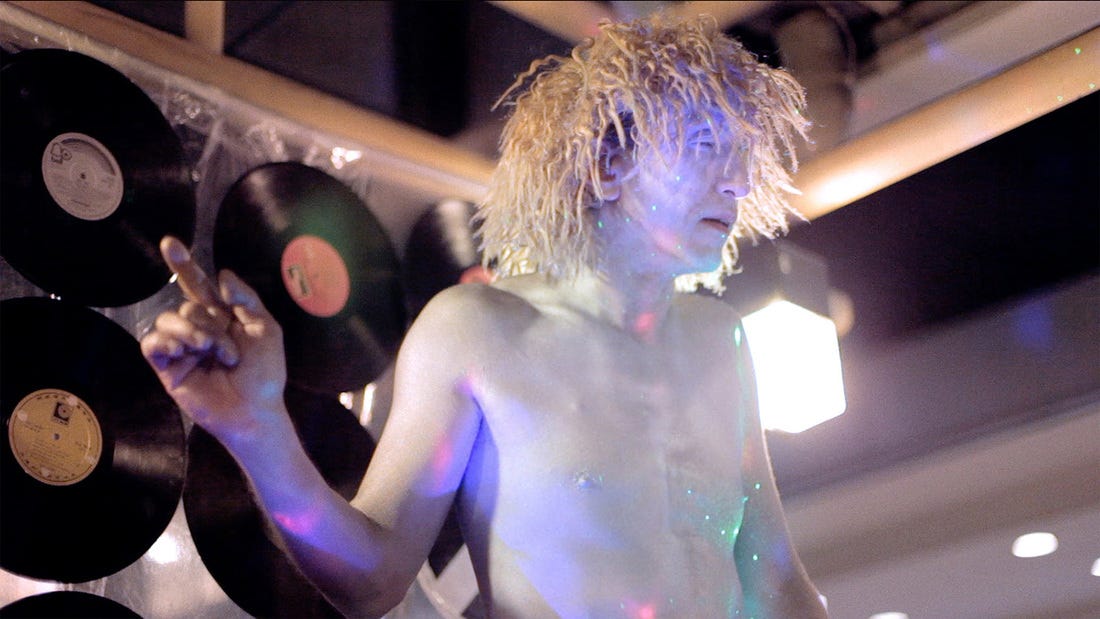
I recently watched a documentary, Singapore Minstrel, by my friend Salty, who I realise has featured quite a lot in this writing. (Thank you, Salty, for being my friend!) Salty directed and produced a beautiful documentary about the legendary street busker Roy Payamal, also known as the 'Silver Man', who was of the TAV generation but existed on a parallel—sometimes intersecting, but no less trailblazing—path. I bought a book of Roy's poems entitled STREETFOUND at the film screening of Singapore Minstrel. (Roy, you are my idol!) His poems are beautiful and strange, and they make me cry when I read them. Roy is one of those magical people who is totally from another dimension—I knew of him because people kept telling me that he is very Butoh, which I concur. I think this magical quality of Roy's protected him from being co-opted into the system (also, he had little desire to be a part of it). He also reminds me of my late friend, the psychopomp Paul, who was another one of these mythical and otherworldly beings who managed to exist outside of institutions, yet whose art was more potent and transgressive than anyone's. In Roy's book of poetry, an Artist Village pioneer and one of his peers, Zai Kuning, writes this of him:
Roy is one of the great street artist (Orchard Road) who grew up on the street and could barely be told what to do even if he agree to work in theatre environment where many aspect of performance can be rigid, calculative, controlled and lack the sense of improvisation. For that reason he did not really find himself working with much on theatre production. He preferred to be seen on the street alone and aloneness has become the essence of his art or street art. What makes it alive is sense of improvisation.
Payamal, Roy. STREETFOUND: Writings & Images. Edited by Salty Xi Jie Ng, 2021.
Essay: Growing Madness - a note by Zai Kuning
People in the arts did ask me do I think what Roy do is Performance art or clowning around. Well, you see I don’t busy myself nor pay much attention on terminology and the grammar of it, as what matter is, the whole idea is to perform anywhere we wish even without an audience while in 7-11 with cashier staring wondering about (if this person is) mad or not and the police.
Payamal, Roy. STREETFOUND: Writings & Images. Edited by Salty Xi Jie Ng, 2021.
Essay: Growing Madness - a note by Zai Kuning
Roy Payamal is the wildest busker of a country ranked the world’s most emotionless society.
Write-up of Singapore Minstrel on Salty’s Website. Source
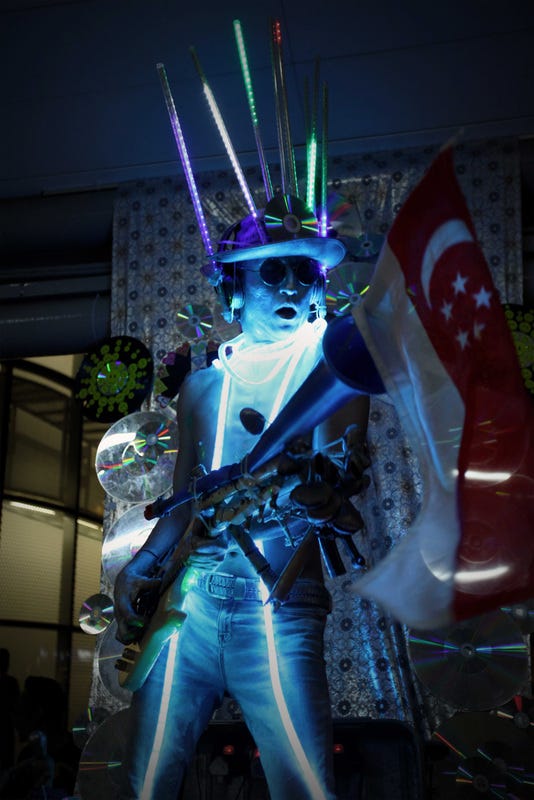
As we can infer from the government's stance on "unpredictable art," Roy would be incomprehensible to them because his art exists completely on his own terms. I like the notes on Roy by Zai Kuning (whom I have never met in person) a lot, and I am grateful to my friend Salty, who has taken on so much of the labour of documenting, preserving, and archiving Roy's work. Otherwise, people like me—who have been running away from Singapore—would have had nothing to find when we came back. People like Roy and many others are the patron saints of Singapore's avant-garde; they nourish my belief that this kind of work can still exist here. This is the true delight of the artist and the reward for our efforts—an ungovernable spirit. This is something of what the art of Butoh has taught me as well: that to make art freely is to surrender to the process, and even if I have to do it within a cage, I can still find some form of freedom if I honour my true impulses—the ability to make art that comes from the sacral and not from mandate.
If I die, I may want Want To come back again, And be Born in Singapore
And so, despite all my frustrations, I still choose to live and share my art on this island — to dance with the disappointments, the circadian rhythms of heartbreaks and the highs of impossible things made manifest and to witness the powerful change affected from a persistence that comes from love.
Don’t give up!
Notes and Disclaimers
On omitted lineages: This writing does not extensively cover the pioneering female performance artists of the 1970s and 1980s. This is not an attempt to erase or discredit their contributions — only a practical constraint of length. Their work deserves its own space, which I hope to give another time.
On scope: A proper account would also look at Singapore's theatre and dance scenes — their own histories, their own negotiations with the state and their role in the airs. I have not done that here, only because I don't have the right to speak for them. I can only speak for the practices I am familiar with.
On AI use and its costs: I used the AI Deepseek to help clean up my citations and assist in the writing of this piece. I recognise this is not without ethical complication — like all AI, it carries an environmental cost. Of the available tools, I still find Deepseek the least offensive for three reasons: it is not American-owned, it does not fund war, it does not currently monetise user data.
On accuracy: Some historical facts in this writing may be incorrect. I am not a scholar, only an artist trying to piece together a lineage. If you spot any inaccuracies or wish to share your thoughts and feedback please write to me: xue.scxl@gmail.com.
Works Cited
The Artists Village. Brief History of The Artists Village. Asia Art Archive, 2008, cdn.aaa.org.hk/_source/lwe-01418.pdf.
The Artists Village. The Artists Village: Chronology of Events. Asia Art Archive, 2008, cdn.aaa.org.hk/_source/lwe-01419.pdf.
The Artists Village. Untitled [Post-Ulu Documentation]. YUMPU, 2008, www.yumpu.com/en/document/view/40126972/untitled-the-artists-village/34.
“The Artists Village - Singapore.” Artfactories, 2009, www.artfactories.net/The-Artists-Village-Singapore.html.
Future of Imagination. Home, n.d., www.foi.sg/.
Goh, Wei Hao. “Performing Protest in Singapore: Performance Tactics in Brother Cane and Don’t Give Money to the Arts.” Konsthistorisk tidskrift/Journal of Art History, vol. 92, no. 1, 2023, pp. 36–55. Taylor & Francis Online, https://doi.org/10.1080/00233609.2023.2181864.
Hoe, Su Fern. “The Art of Govt Funding Still a Work in Progress.” Channel NewsAsia, 3 Aug. 2017, www.channelnewsasia.com/today/voices/art-govt-funding-still-work-in-progress-5560471.
Koh, N. H. “Early Performance Works by Tang Da Wu in Singapore.” Art Journal, vol. 77, no. 4, 2018, pp. 49–61. EBSCOhost, accessed via NLB’s eResources website.
Kuo, Pao Kun. Contradictions: Essays on Art, Culture and the Nation. The Substation, 1997.
Langenbach, Ray. Brother Cane. 1994. Analog video documentary.
Langenbach, Ray. “Leigong Da Doufu: Looking Back at ‘Brother Cane’.” Looking at Culture, edited by S. Krishnan et al., Chung Printing, 1996, pp. 123–136.
Langenbach, Ray. Looking Back at “Brother Cane”: Performance Art and State Performance; the Performative Indoctrination Model. Artspace Visual Arts Centre, 1997.
META-GRAPHY. DECK Photography Art Centre, 2023, deck.sg/happening/meta-graphy/.
Ministry of Culture, Community and Youth. Artists’ General Assembly (AGA) Incident: Statement on Prosecutions. Government of Singapore, 1994.
Morelli, Naima. “The Singapore Series — Chapter 18: Brother Cane and the Josef Ng Affair.” Naima Morelli, 4 Mar. 2019, www.naimamorelli.com/singapore-series%E2%80%8A-%E2%80%8Achapter-12-2/.
National Arts Council. *Annual Report FY2024/2025*. Government of Singapore, 2025.
National Arts Council. Our SG Arts Plan (2023–2027): Building a Connected Society, a Distinctive City, a Creative Economy. Government of Singapore, 2023.
Ng, Josef. Brother Cane. 1994. Performance at Artists’ General Assembly, 5th Passage, Parkway Parade, Singapore.
Quek, Bruce. “Tang Da Wu.” National Library Board Singapore, 27 Oct. 2025, www.nlb.gov.sg/main/article-detail?cmsuuid=03677f95-1db0-4a99-93e7-deecc971a07b.
Say, Jeffrey, and Yu Jin Seng, editors. Histories, Practices, Interventions: A Reader in Singapore Contemporary Art. Institute of Contemporary Art Singapore, 2016.
The Substation. The Substation to Close Permanently on 12 July 2021. 12 Mar. 2021, www.substation.org/the-substation-to-close-permanently-on-12-july-2021. Press release.
Tan, Amanda. “The Substation: A Post-Mortem.” The Artist Speaks: Lee Wen, edited by Bruce Quek, National Gallery Singapore, 2021, pp. 98–105.
Tan, K. P. “The Funding Contradiction: Supporting Art Without Controlling It.” CNA/TODAY, 20 Mar. 2017, www.todayonline.com/.
Wikipedia contributors. “The Artists Village.” Wikipedia, The Free Encyclopedia, 2024, en.wikipedia.org/?curid=18990801.
Tang Da Wu, Earth Work exhibition, National Museum Art Gallery, 1980. The director shut the exhibition down after three days, complaining that “earth and lumps of clay shouldn’t be in the museum.” My Art Guides, “Earth Work 1979,” accessed June 14, 2026.
Tang Da Wu successfully reopened the exhibition in 1980 at a different venue. My Art Guides, “Earth Work 1979.”
George Chua is an artist based in Singapore working with sound and body. His work is characterised by a resistance towards consistencies and categorisation, often blurring the lines between disciplines and genres. Everything can flow into everything else. His main interests: dance, sitting still, the performative act, animal noises, electronic crackles, the unnameable. (George’s bio from the Esplanade)
Wikipedia contributors. (2024). The Artists Village. In Wikipedia.
https://en.wikipedia.org/?curid=18990801
Hit hard and I feel like this is one of the things I'm going to have to come back to and read a few times - from anecdotes to tidbits of history to arts vs policy to just a reminder for myself to not give up!! Thank you for this Xue
thanks for writing this, it was a pleasure to read. could i ask how you think institutions like the state should measure "success" or "progress" for the arts industry -- given that output-oriented KPIs aren't good enough? i agree that focusing on output in the arts leaves a lot to be desired...but what would a process-oriented KPI actually look like? would love to hear your thoughts.